In today’s business environment, organisations of all sizes are turning to automation, whether through process-automation, workflow automation, HR automation, or intelligent/AI-powered systems, to drive efficiency, scale operations, improve the employee/candidate experience, and free up human time for higher-value work. However, despite the proven benefits, a number of myths and misconceptions still hold back many teams from making the leap.
As a PeopleOps professional writing for technical and business audiences alike, this blog will unpack some of the most common myths about automation, explain the realities behind them, share real-world scenarios, and highlight how PeopleOps can help you navigate this transformation smoothly.
Why it matters
When organisations hesitate because of myths rather than facts, two things tend to happen:
- They continue to burden HR/Operations with repetitive, low-value tasks (data entry, approvals, status chasing) instead of spending time on strategic work like talent development, culture, analytics.
- They implement automation poorly, leading to failed initiatives, frustrated staff, minimal ROI and then use that failure to justify “automation isn’t for us”.
According to recent research:
- One blog on process automation notes that the myth “automation delivers immediate results” is common but unrealistic. RoboSource+1
- Another found that even smaller organisations can benefit from automation the myth that “only large enterprises can afford automation” is outdated. Ortom8+1
- Studies also highlight that automation doesn’t replace human judgement but rather augments it, freeing people for other work. Camunda+1
So let’s dive into five major myths, the truth behind them, and how PeopleOps can help make the reality work.
Myth 1: “Automation will replace human jobs”
The myth
One of the most pervasive fears: that automation means robots or software will come in and eliminate jobs, leaving people redundant. This is especially present in HR/PeopleOps discussions, “Will automation take my job away?”
The truth
- Automation (especially in HR/PeopleOps) is not about replacing humans but augmenting them. As one analysis put it: “Automation cannot perform like a human worker … It simply takes over hours-long, repetitive tasks thereby freeing up staff for the jobs that this bot cannot do.” OpenSky
- In practical terms: HR automation frees up the team from mundane tasks (forms, data updates, status chasing) so they can shift time to coaching, strategic planning, culture building, analytics.
- From a workforce perspective: A 2024 survey of ~9,000 workers across nine countries found that more workers anticipated benefits (safety, autonomy, pay) from automation than costs, when implemented well. arXiv
Real-world scenario
Consider an HR team at a mid-sized tech company. They were spending dozens of hours every month manually chasing onboarding forms, benefits enrolments, and offboarding tasks. They implemented an HR workflow automation tool. Rather than reducing the headcount, the team shifted to spend those freed hours on onboarding experience design, mentoring new hires, and analysing attrition trends. The employees felt better supported and the HR team had more strategic bandwidth.
How PeopleOps can help
- Start with task inventories: identify high-volume, low-judgement tasks suitable for automation (data updates, notifications, status trackers).
- Communicate clearly: automation will not eliminate human roles but transform them, emphasise the shift to higher-value work.
- Plan for change management: include training, involve people in design, address concerns proactively (job security, role shifts).
- Monitor outcome not just cost: measure how team time is spent after automation and what value is unlocked.
Myth 2: “Only large enterprises can afford automation”
The myth
Many teams believe automation is reserved for big corporations with deep pockets, huge IT resources, and complex operations. That holds many smaller or mid-sized organisations back.
The truth
- Modern automation platforms (cloud hosted, SaaS, low-/no-code) make automation accessible to smaller teams and organisations. RoboSource+1
- Implementing automation doesn’t have to mean large “big bang” projects. You can start small (pilot a process) and iterate. Many vendors offer “starter” modules.
- According to a workflow automation article: “Cloud solutions reduce setup costs; no-code/low-code platforms remove technical barriers; subscription pricing makes it affordable.” Kissflow
Real-world scenario
A 150-person services firm had no dedicated automation team. They deployed a simple workflow tool (with approval routing, notifications) to automate expense reimbursement and travel request approvals. The cost was modest, the IT effort minimal, and within months the finance and HR teams were spending far less time on those repeat tasks. The success built momentum for deeper automation.
How PeopleOps can help
- Help select entry-point use cases: low risk, high volume, measurable benefit (e.g., leave requests, onboarding checklists, exit formalities).
- Use proof-of-concept: show early wins with minimal investment, build internal confidence.
- Leverage cloud/low-code tools: reduce dependency on heavy IT custom development.
- Present scalable roadmap: once the base is working, extend to more complex use cases.
Myth 3: “Automation gives instant results / is a one-time implementation”
The myth
Some believe you flip the “automation switch” and instantly get all the benefits, less effort, fewer errors, more productivity, forever with no further effort.
The truth
- Automation is rarely “set-and-forget”. It requires ongoing monitoring, maintenance, and optimisation. As noted: “Automation is not a one-time expense … you’ll need to support, refine, monitor the automations over time.” RoboSource+1
- Results don’t always manifest immediately. There’s a ramp-up: process redesign, testing, training, culture changes. One source: “Many people expect automations to go live and PRESTO! the work just gets done … That’s idealistic (but rarely accurate).” RoboSource
- Change management matters: employees adapting to the new process, monitoring edge-cases, handling exceptions all take time.
Real-world scenario
A global company implemented a robotic-process-automation (RPA) bot for invoice processing. They expected immediate 80 % time savings, but in reality: they spent several weeks stabilising the bot inputs, handling exception cases, training staff, and refining the workflow, the full benefit only emerged after two quarters.
How PeopleOps can help
- Set realistic expectations: automation is an iterative journey, not a magic bullet.
- Build in phases: pilot → refine → scale.
- Monitor metrics: time saved, error reduction, employee satisfaction, workflow throughput. Revisit regularly.
- Maintain governance: who monitors the automation? How to handle exceptions when processes change or software updates?
- Align with continuous improvement: treat automation like any operational capability, evolve, improve, adapt.
Myth 4: “Automation is only for repetitive, simple tasks (or only certain departments like IT)”
The myth
The perception: automation only makes sense for basic, high-volume, “boring” tasks (data entry) and mainly for IT/operations. Other functions (HR, recruiting, decision-making) are exempt.
The truth
- While automation often starts with repetitive tasks, the scope continues to expand, workflow automation, HR workflow orchestration, decision-support, employee lifecycle tasks. For example, a blog noted that workload automation (WLA) is “not only for IT departments” but applies to HR, customer-service, finance. Ortom8+1
- Automation doesn’t eliminate the human judgement required for complex tasks; rather, it supports and augments it. The key is distinguishing what to automate vs what to keep human.
- The maturity of automation platforms (including low-/no-code, intelligent workflows) means broader functions can now leverage automation.
Real-world scenario
An HR team automated the candidate communication workflow: when a candidate advances to a certain stage, an email and calendar invite are triggered, documents are shared, RAG status is updated. That didn’t replace recruiters but freed them from manual logistics and allowed them to focus more on candidate experience and interviewing. Similarly, onboarding workflows automatically create IT tickets, access provisioning, welcome emails again human-led but system-enabled.
How PeopleOps can help
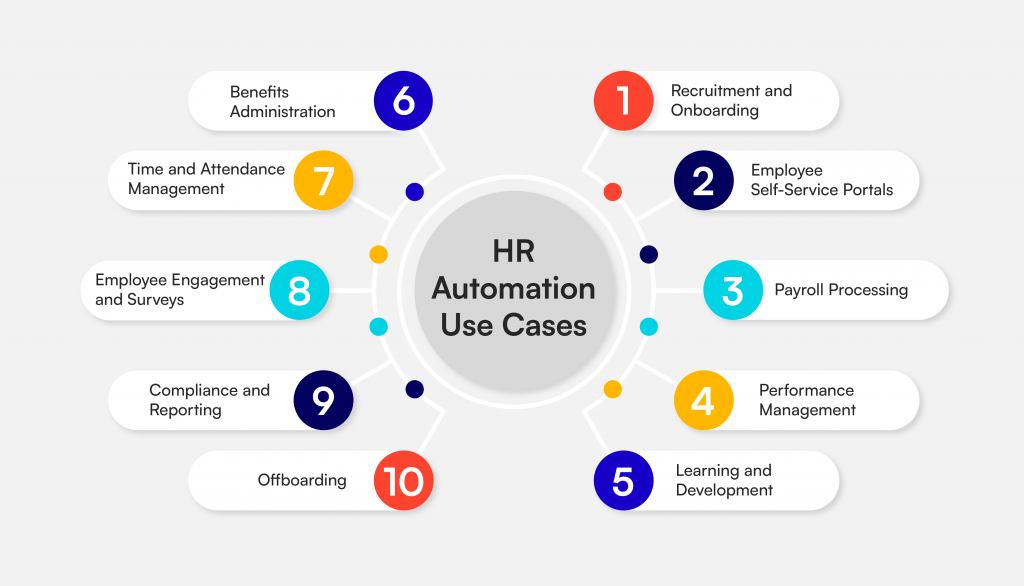
- Map entire employee lifecycle: from recruiting → onboarding → performance → off-boarding. Identify which parts are ripe for automation.
- Ask: “Which tasks are high-volume, rules-based, repetitive?” Those are good candidates for automation.
- Also ask: “How can automation support human judgement instead of replace it?” For example, automated alerts for performance review scheduling, but humans still lead the review.
- Ensure cross-functional visibility: working with IT, operations, HR ensures the automation isn’t siloed.
Myth 5: “Automation is too expensive or complex to implement”
The myth
This ties into Myth 2 (only for large companies) but focuses on cost/complexity: integrating bots or automation workflows is assumed to require huge budgets, heavy custom code, months of disruption.
The truth
- While there is cost and effort (no free lunch), the ROI often justifies the investment. For example, a workflow automation firm noted some organisations achieved ROI in one year between 30 %–200 % by replacing manual workflows. Kissflow+1
- Off-the-shelf tools, SaaS platforms, cloud automation make the barrier to entry much lower than before. Some tools even offer free tiers or start with small modules. RoboSource
- Complexity often comes from process redesign and change-management, not just the technology. So cost/complexity is less about “automation is inherently hard” and more about “we didn’t prepare the process/human side properly”.
Real-world scenario
A mid-sized company with 300 employees used a SaaS workflow automation tool to automate internal travel-request approvals: once a travel request was submitted, the manager gets a notification, HR gets a checklist, finance is notified. Implementation took 4 weeks, cost under budget, and they recouped the cost within six months due to fewer errors, faster turnaround, and less chasing.
How PeopleOps can help
- Conduct a cost-benefit analysis: quantify how many hours are spent on the current process, error rate, turnaround time, and what you expect to gain from automation.
- Choose vendor solutions suited to your size: SaaS, modular, low-code.
- Factor in process redesign and people change: these often add hidden costs and delays.
- Build a roadmap: start small, show value, reinvest.
- Measure success: time saved, employee satisfaction, error reduction, faster time-to-hire/onboard.
Bonus Myth: “Automation = Artificial Intelligence / Magic AI will handle everything”
The myth
Some believe that simply deploying AI will instantly make the organisation efficient, “we’ll drop AI in and jobs will be done automatically”.
The truth
- As one article states: “AI isn’t a magic wand that instantly grants you organisational efficiency. While it can be incredibly powerful, it still requires careful guidance and human oversight.” Nintex+1
- Automation and AI are complementary but distinct. Many tasks are best suited to rule-based workflow automation (i.e., “If A then B”) rather than full AI-driven decision-making.
- You still need to define what problem you want the AI/automation to solve, integrate with your data, monitor performance, handle exceptions.
- Over-reliance on automation without human governance can lead to issues (e.g., automation bias, trusting automated decisions blindly) Wikipedia
Real-world scenario
A company implemented a chat-bot (AI-powered) for candidate FAQs during recruitment. The concept was sound but initial rollout struggled: the bot could answer standard questions, but when candidates asked atypical questions, it failed. The team had to build fallback workflows, human-handoff logic, content updates and monitor data to refine the bot. The learning curve reinforced that AI + automation still need human oversight.
How PeopleOps can help
- Choose appropriate automation level: start with rule-based workflows; add AI/ML only when there’s sufficient data, clear business case, and capacity to monitor.
- Ensure governance and transparency: define who monitors the automation/AI, how exceptions are handled, how data is managed, and how humans intervene.
- Communicate clearly with staff: automation/AI is a tool, not a replacement; human judgement remains key.
- Build feedback loops: monitor performance, gather user feedback, refine the models/workflows.
Why PeopleOps should lead, not just observe
In many organisations, automation is seen as an IT or operations initiative. But as PeopleOps professionals, you’re ideally placed to lead the automation push here’s why:
- You understand the employee lifecycle end-to-end: recruiting, onboarding, performance, off-boarding. That gives you a rich map of where automation can add value.
- You’re the bridge between people, process, and technology: you can ensure that automation supports the human side (experience, culture) and the process side (efficiency, accuracy).
- You can ensure the change management and culture aspects are handled, technology alone won’t succeed if staff feel insecure or confused about the role of automation.
- You can align automation with strategic HR/PeopleOps goals: e.g., faster time-to-hire, better onboarding experience, higher employee engagement, fewer errors/risks.
Key Takeaways & Action Checklist
Key takeaways
- Automation is not about replacing humans — it’s about letting humans do higher-value work.
- Automation is not only for large organisations — small and mid-sized teams can implement it with modern tools.
- Automation is not a one-time fix or “quick win” alone — it requires planning, process redesign, monitoring, iteration.
- Automation is not just for repetitive tasks in IT — it spans across functions (HR, finance, customer-service) and supports human judgement.
- Automation is not magic AI — you need to define the problem, choose the right tools, and govern the process.
Action Checklist for PeopleOps
- Audit your processes: Identify tasks that are repetitive, rule-based, high-volume and time-consuming.
- Prioritise quick wins: Choose one or two processes (e.g., onboarding checklist, leave requests, expense approvals) for pilot automation.
- Engage stakeholders: Involve HR/PeopleOps, IT, operations, end-users (employees/managers) early. Clarify purpose, roles, benefits.
- Choose your tool/approach: Determine if you need simple workflow automation, RPA, or an end-to-end automation platform.
- Define metrics: Before implementation, define what success looks like: time saved, error reduction, employee satisfaction, number of steps eliminated.
- Communicate and train: Explain to teams why automation is coming, what will change, how it affects roles, emphasise augmentation, not replacement.
- Roll out, monitor, refine: Use a phased approach, collect feedback, monitor exceptions, refine automation logic.
- Scale and iterate: Once pilot succeeds, expand to other processes, incorporate more complex workflows or intelligent automation where appropriate.
How PeopleOps Can Help YOU
At PeopleOps (your organisation), we specialise in helping organisations navigate the human-centred side of automation. Here’s how we can support:
- We help you map employee/HR processes, identify automation-friendly tasks, and prioritise initiatives.
- We facilitate stakeholder workshops to align goals (HR leaders, IT, operations, business leaders) and ensure a smooth change journey.
- We assist in vendor selection (workflow tools, RPA, low-code platforms) tailored to your size and budget.
- We support change management: communication plans, training programs, managing cultural shifts, managing staff concerns.
- We define success metrics and dashboards, tracking automation benefits (time saved, cost reduction, employee experience improvement).
- We help build a roadmap for continuous improvement: automation isn’t a one-off; we help ensure your organisation evolves and scales intelligently.
Conclusion
Automation holds tremendous potential for HR, PeopleOps, operations, and the wider business but myths and misconceptions continue to hold organisations back. By understanding the realities behind those myths and adopting a strategic, people-centric approach to automation, you can unlock real value: more time for meaningful work, better employee experience, fewer errors, faster processes, and a more agile organisational capability.
If you’re ready to explore automation in your PeopleOps domain, from recruiting to onboarding to performance workflows and want to do it in a way that aligns with both business drivers and human experience, let’s connect.
Leave a Reply