Introduction
In today’s fast-moving business world, both technical and business leaders expect the finance and operations functions to do more than simply record transactions. They want visibility, control, agility, and insight. That means your AP (Accounts Payable), AR (Accounts Receivable), Payroll, and Reporting processes must not only exist, they must be mature.
“Maturity” means processes are reliable, consistent, automated, scalable, and aligned with strategic goals. A maturity-based audit helps you assess where you are, what gaps exist, and how to improve.
In this article we will:
- Define why auditing maturity across AP, AR, Payroll and Reporting matters.
- Highlight common problems and pain-points in each area.
- Provide a scoring template (with maturity levels) you can apply.
- Show how PeopleOps (or your finance/ops team) can help deliver improvements.
- Share real-world relevant scenarios and best practices.


Why Maturity Audits Matter
- Risk & compliance: For example, in AP missing accruals or unrecorded liabilities can understate payables. CPA Hall Talk+2drpa.org+2
- Efficiency & cost: Manual, inconsistent processes cost more, take longer, and are more error-prone.
- Business alignment: Mature functions support strategic decisions (not only “what happened” but “what’s next”). For example a finance maturity model emphasises technology, data, process, and roles. Prophix+1
- Scalability: As the organisation grows, immature processes collapse.
- PeopleOps role: HR/PeopleOps often intersect with payroll, reporting and systems; a maturity audit helps them co-ordinate with finance, IT, operations.
Key Domains to Audit
We focus on four domains:
- Accounts Payable (AP)
- Accounts Receivable (AR)
- Payroll
- Reporting & Analytics
Each domain has its own maturity dimensions (people, process, technology, data) and pain points.
1. Accounts Payable (AP)
Typical problems / pain-points
- Late invoice processing, missing approvals
- Lack of vendor master-file control (duplicate vendors, bogus vendors) drpa.org
- Weak segregation of duties (same person adds vendor, approves invoice, issues payment) CPA Hall Talk
- Manual workflows, lack of audit trails
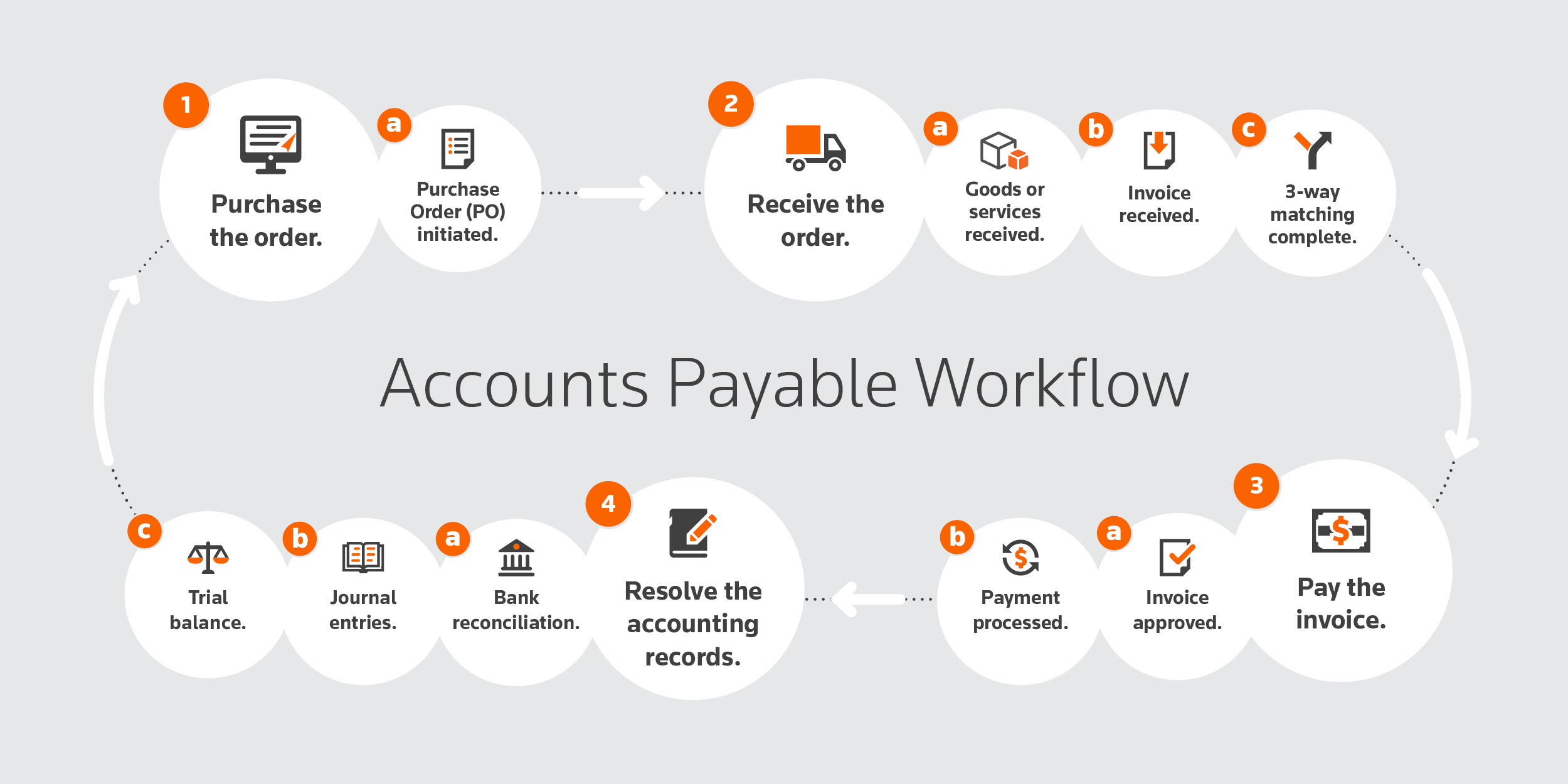
- Poor matching of purchase orders / receipts / invoices
- Unrecorded liabilities (expenses incurred but not yet invoiced) CPA Hall Talk+1
Maturity-scoring template
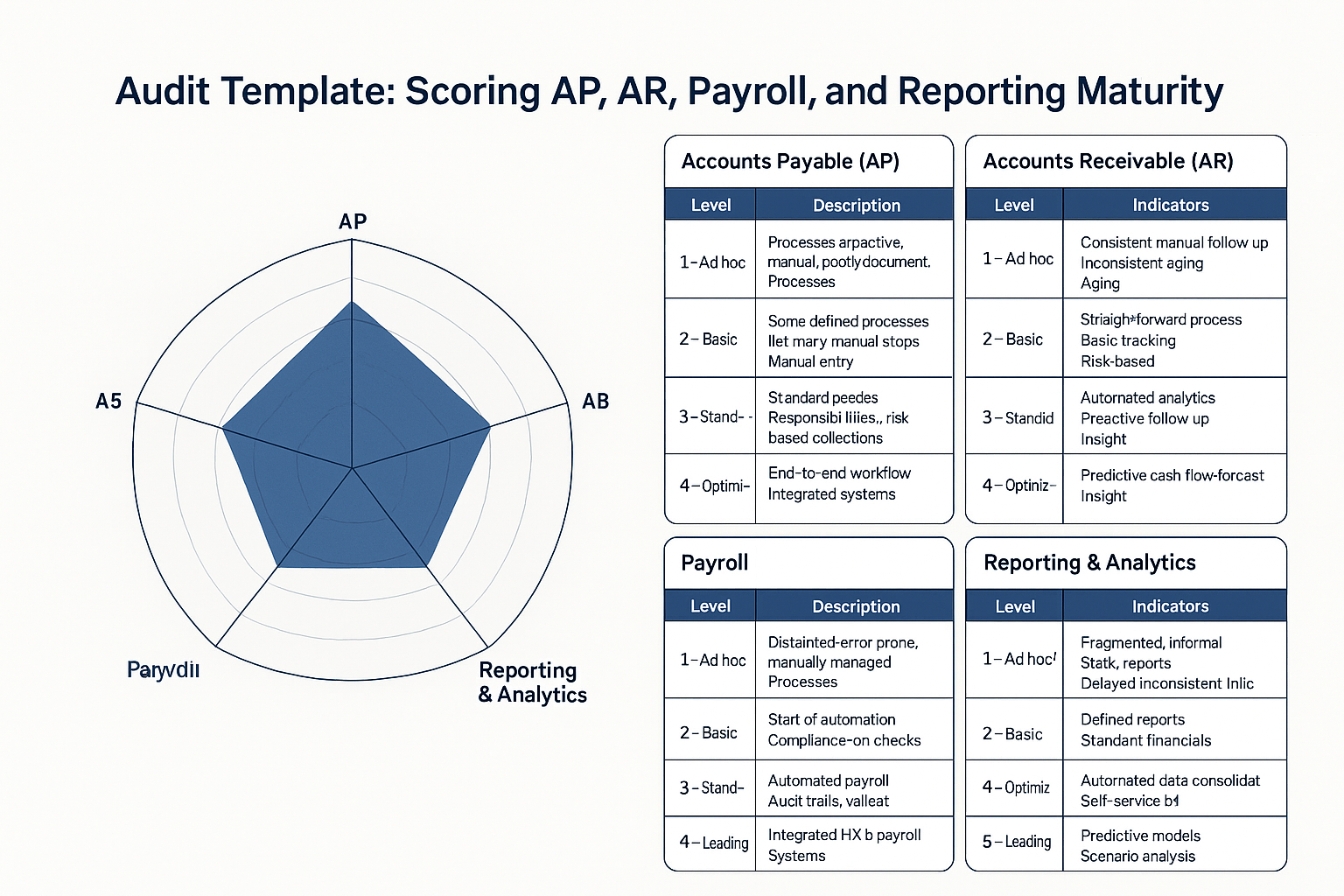
| Level | Description | Indicators |
|---|---|---|
| 1 – Ad hoc | Processes are reactive, manual, poorly documented. | Many exceptions, long cycle times, limited controls. |
| 2 – Basic | Some defined process, but still many manual steps. | Manual entry, some vendor file controls, but weak matching. |
| 3 – Standardised | Process defined, responsibilities clear, some automation. | Electronic approvals, vendor file governance, metrics tracked. |
| 4 – Optimised | End-to-end workflow, integrated systems, proactive controls. | Automated invoice capture, vendor analytics, exceptions flagged. |
| 5 – Leading/Continuous Improvement | Industry-benchmark practices, continuous feedback, predictive capabilities. | Predictive liability estimation, vendor risk scoring, full audit trail, minimal manual work. |
You can assign a score (1-5) for each dimension (e.g., “Invoice capture & matching”, “Vendor master control”, “Approval & payments”, “Analytics & metrics”) and compute an average or weighted score.
Real-world scenario
A mid-sized manufacturing company found that its AP process was still largely paper based. It took 30+ days to process invoices. After a maturity audit, they moved to level 3: vendor master review, three-way matching, and invoice automation; cycle time dropped to 10 days, duplicate payments fell by 40%.
2. Accounts Receivable (AR)
Pain-points
- Over-reliance on spreadsheets and manual collections
- No prioritisation of high-risk customers / overdue accounts
- Poor visibility on cash conversion, ageing reports Patriot Software+1
- Weak link-up between sales/operations and finance on credit terms
Maturity-template (similar structure to AP)
Dimensions might include: “Credit policy & customer onboarding”, “Invoice & billing automation”, “Collections & follow-up”, “Analytics & cash-flow forecasting”.
Scoring levels same 1-5.
Scenario
A SaaS firm’s AR team spent hours generating ageing reports each month. After moving from level 2 to level 4, they adopted an AR dashboard, triggered automatic follow-ups for > 60-day balances, and improved DSO (days sales outstanding) by 15%.
3. Payroll
Pain-points
- Incorrect pay, missing deductions, non-compliance with tax/regulations. AIHR
- Lack of audit trail and reconciliation (e.g., payroll register not reconciled to general ledger)
- Manual data entry, risk of errors
- Weak integration between HR systems (hiring, terminations) and payroll
Maturity-template
Dimensions: “Data integrity & integration”, “Processing & controls”, “Compliance & auditability”, “Reporting & analytics”.
Again levels 1–5.
Scenario
In a large service organisation, payroll errors and late taxes caused reputational impact. They moved from level 1 to level 3 by integrating HRIS and payroll, automating deduction checks, and performing monthly audits. Error rate dropped from ~5% to < 1%.
4. Reporting & Analytics
Why this matters
Reporting is the interface between operations/finance and business decisions. Without mature reporting, you can’t leverage your AP/AR/Payroll improvements into strategic impact. A reporting maturity model emphasises timely, accurate, insightful outputs. workiva.com+1
Pain-points
- Delayed close and reporting, static spreadsheets
- Data siloes, inconsistent definitions
- Limited forward-looking analytics (mostly historical)
- Manual reconciliations, weak governance
Maturity-template
Dimensions: “Data quality & governance”, “Automation & tools”, “Timeliness & frequency”, “Insights & decision-support”.
Levels 1 through 5.
Scenario
A retail company’s month-end close took 10 days; reports were stale. After assessing reporting maturity and investing in a modern financial close platform, close time was reduced to 3 days, and business units used dashboards for real-time decisions, moving from level 2 to level 4.
Your Audit Template: How to Use It
Step-by-step
- Define scope – Decide which areas (AP, AR, Payroll, Reporting) and which dimensions you’ll assess.
- Gather evidence – Process documentation, system screenshots, performance metrics (cycle times, error rates), interviews with key staff.
- Score each dimension – For each area assign a maturity rating (1-5) using your template. Document justification.
- Aggregate & visualise – Create a radar/spider chart or table showing maturity levels across domains.
- Identify gaps & priorities – Focus on areas with low maturity but high risk or high business value.
- Build improvement roadmap – For each gap define actions (people/process/technology), owners, timeline.
- Monitor & repeat – Use the template quarterly or annually to track progress.
Example of scoring sheet (simplified)
| Domain | Dimension | Score (1-5) | Comments |
|---|---|---|---|
| AP | Vendor master control | 2 | Duplicate vendors found |
| AP | Invoice capture & matching | 3 | Some automation but manual steps |
| AR | Collections & follow-up | 4 | Auto triggers established |
| Payroll | Data integration HR–Payroll | 2 | Manual import still in place |
| Reporting | Data governance & quality | 3 | Data definitions not standardised |
| … | … | … | … |
You might compute a weighted average if some domains matter more.
How PeopleOps can help
- Cross-functional coordination: PeopleOps works closely with HR/Payroll and Finance to ensure clean data (on-boarding, terminations) and integrated systems.
- Change-management & training: Rolling out new workflows (e.g., vendor onboarding, payroll systems) requires training, policy, and governance. PeopleOps adds value.
- Process documentation & governance: PeopleOps can drive documentation of controls, roles and responsibilities that underpin maturity.
- Metrics & people-analytics: PeopleOps can help define KPIs (error rates, cycle times, employee pay complaints) and feed them into maturity assessments.
Best Practices & Tips
- Use consistent definitions across domains (what “maturity level 3” means in AP should be aligned with what it means in Reporting).
- Engage key stakeholders early, finance, operations, HR, IT. A maturity audit isn’t just a compliance exercise; it’s a transformation opportunity.
- Focus on value-drivers, not just technology. Automation alone doesn’t equal maturity; process and people matter. This aligns with financial maturity thinking: skills, technology, relationships, process. Prophix
- Make your roadmap practical, start with quick wins in high-impact areas.
- Use data: cycle times, error rates, cost per invoice, DSO, close time. These metrics make maturity tangible.
- Repeat the audit periodically; maturity is not a one-time checkbox but a continuous improvement journey.
Conclusion
Auditing maturity across AP, AR, Payroll and Reporting gives your organisation a clear-eyed view of current state, hidden risks, and improvement opportunities. It enables finance and PeopleOps teams to move from fire-fighting to foresight.
By using a scoring template, grounding your assessment in real evidence, and linking to strategic business goals, you turn process audits into business-value drivers. Whether you’re at maturity level 1 or moving toward level 4 or 5, the key is clarity, roadmap, and momentum.
Leave a Reply