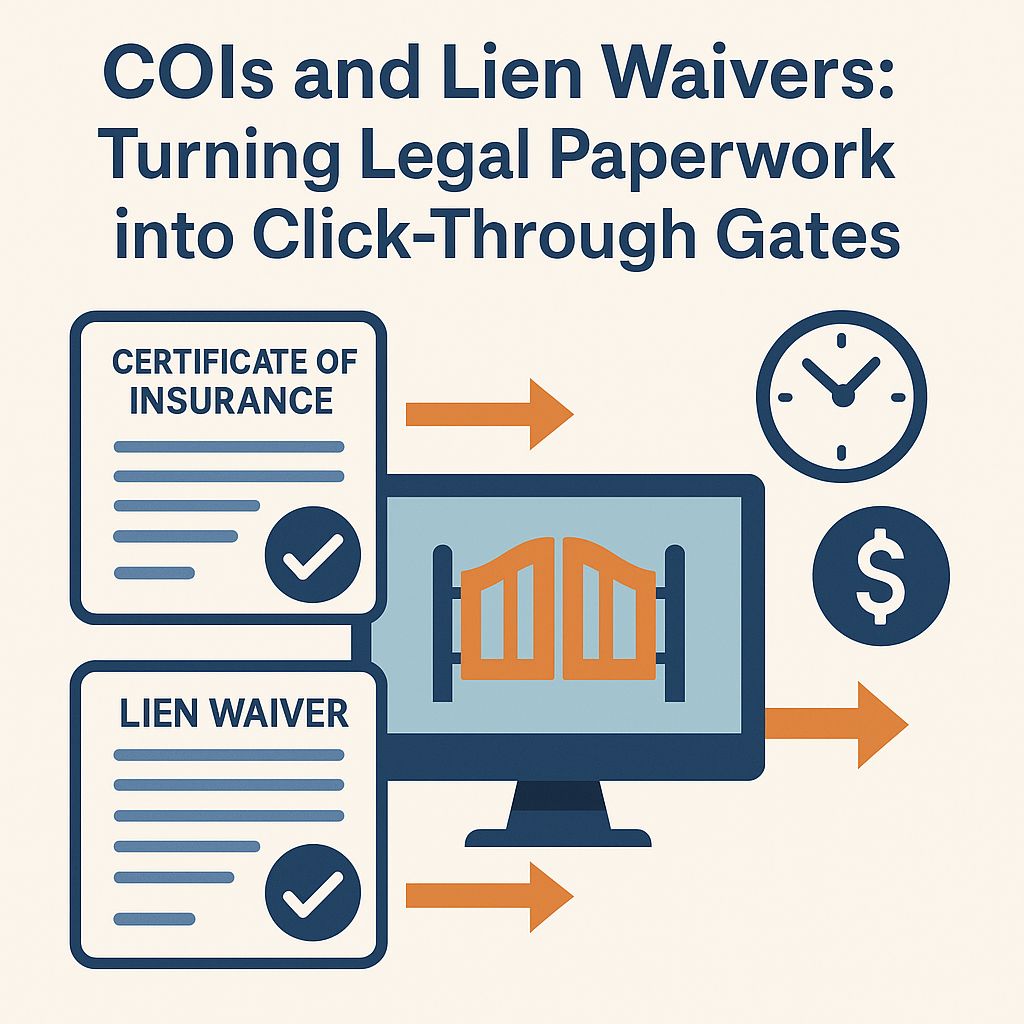
1. Introduction: Why these documents matter
In the world of construction, real-estate development and major infrastructure projects, two pieces of legal paperwork consistently create friction: the Certificate of Insurance (COI) and the Lien Waiver. On the face of it, they are dry documents, one shows someone is insured, the other shows someone won’t file a lien. But for operations, procurement, legal, finance and PeopleOps teams, they are gates: they determine whether you proceed to the next stage of work, payment or onboarding.
If you treat them as “just paperwork”, you’ll find delays, risk exposures and bottlenecks. If you treat them as click-through gates, checkpoints you design for your process, automate when possible, track consistently, then you turn them into business enablers rather than blockers.
In this article we’ll:
- Explain what COIs and lien waivers are (with up-to-date definitions)
- Explore the pain-points many teams face
- Show real-world scenarios where failure or friction cost money/time
- Describe how PeopleOps, Risk/Insurance, Finance teams can set up smarter digital flows (make them click-through gates)
- Offer best practices and tips.
2. What is a COI (Certificate of Insurance)


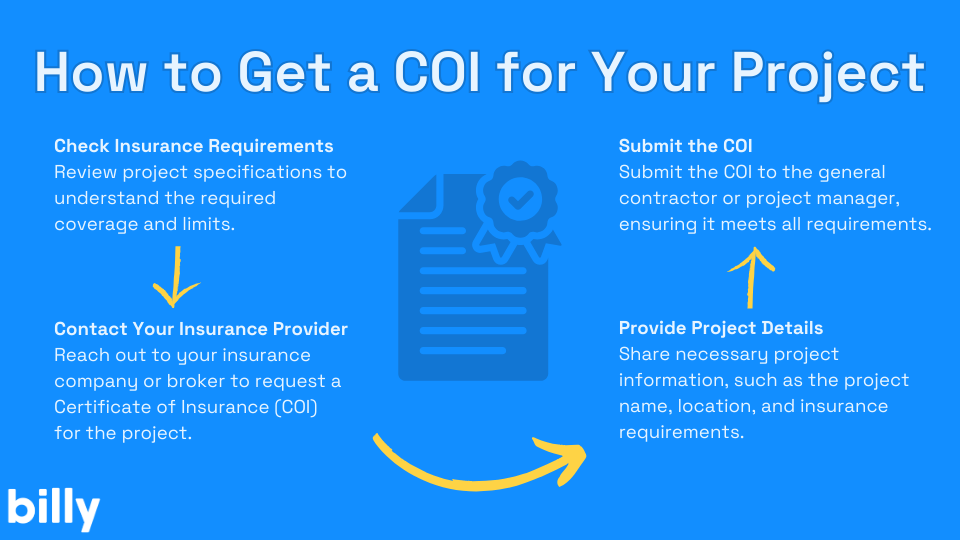
Definition & purpose
A COI is a document issued by an insurer or insurance broker that summarises key terms of a policy. It tells a third-party (for example a project owner or general contractor) that the contractor or subcontractor has active insurance with certain coverages, limits and endorsements. redhammer.io+3Investopedia+3Procore+3
In construction (or other high-risk industries) the project owner or general contractor often requires the subcontractor or vendor to provide a COI before work begins, to ensure risk is appropriately allocated. myCOI | myCOI+1
Key fields / what you should check
When you review a COI, you should check at least:
- Insured entity name (is it the correct legal entity?)
- Policy types (General Liability, Workers’ Comp, Auto, Umbrella etc)
- Policy limits and effective/expiration dates. crewcost.com+1
- That the certificate holder (your company / project owner) is named, or that you are listed as an additional insured (if required). Billy+1
- That cancellation/endorsement language is acceptable (i.e., you’ll be notified if the policy is cancelled). redhammer.io
Why it matters (pain-points if missing)
- Without a valid COI you effectively bring on a vendor who may be uninsured or underinsured → if there is an injury or damage, your organisation may be liable.
- Projects are delayed because procurement/legal won’t let a subcontractor mobilise without COI.
- If the COI expires mid-project, you may lose insurance protection during the work.
- Tracking many COIs manually is error-prone; you may accept invalid COIs accidentally.
3. What is a Lien Waiver

Definition & purpose
A “mechanic’s lien” (or simply “lien”) is a legal claim a contractor, subcontractor or material supplier can place on a property if they are not paid for work they performed or supplies provided. Wikipedia+1
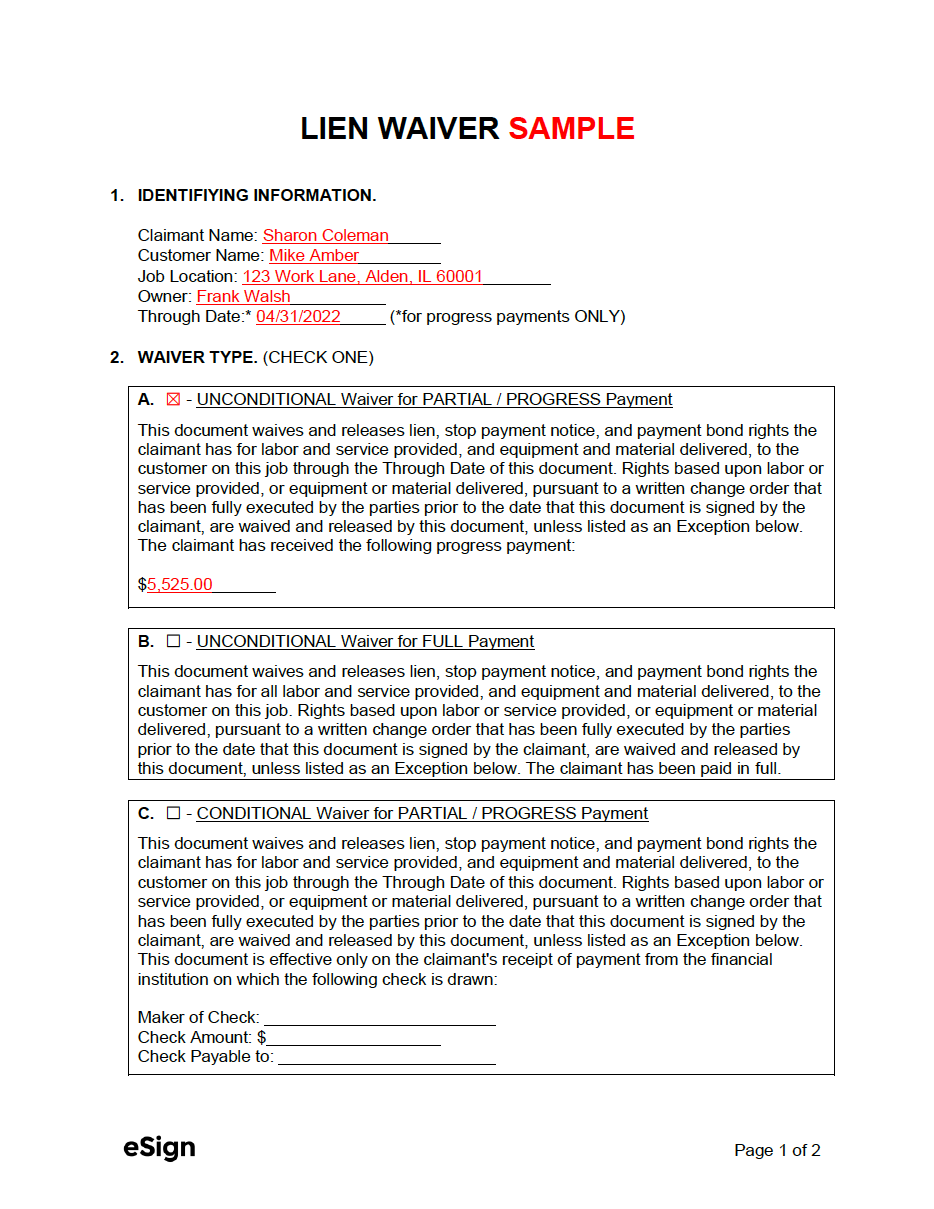
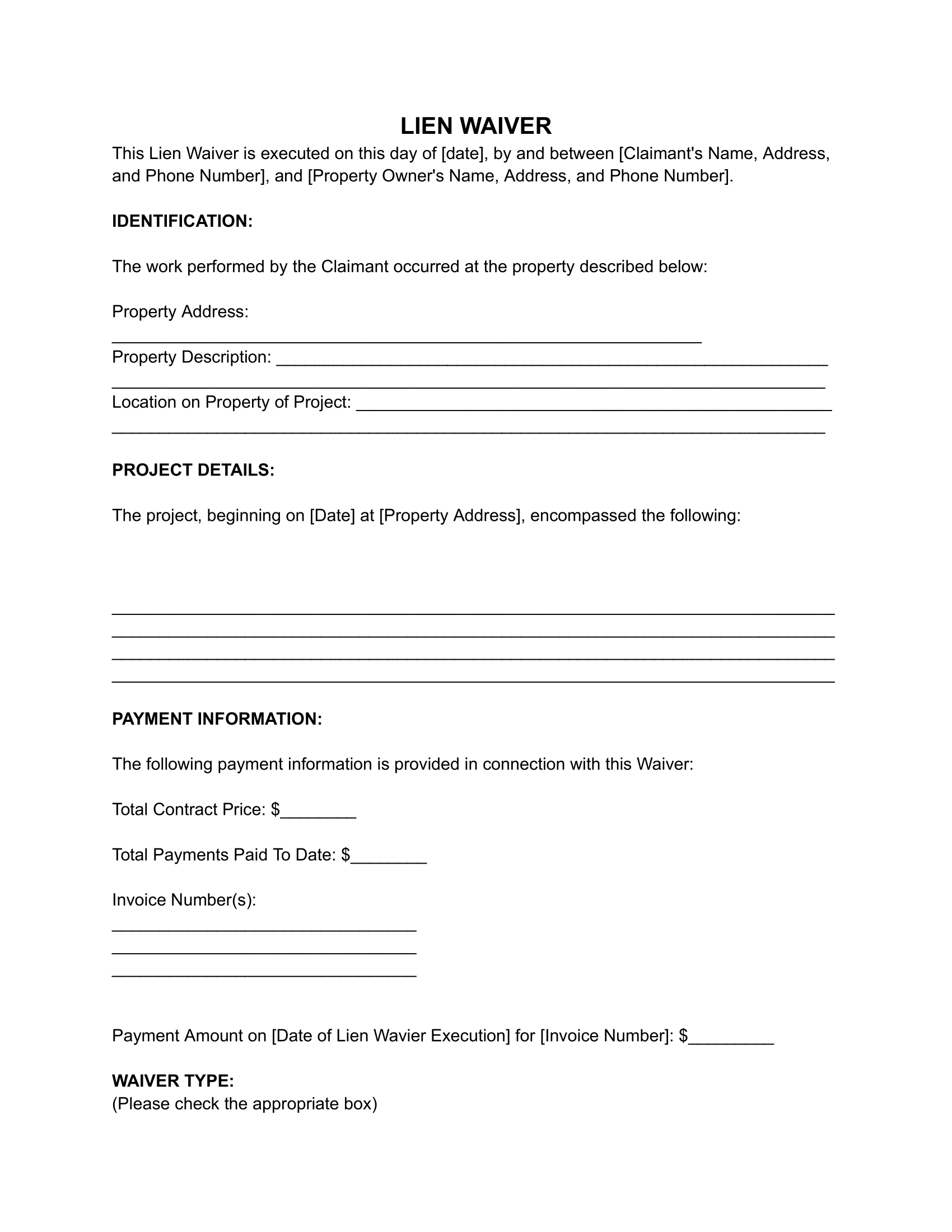
A lien waiver is a document in which that party agrees not to place a lien (or gives up the right) for a specified amount of work/supplies, often in exchange for payment. Buildertrend+1
Types and when to use them
There are multiple types. Key distinctions:
- Conditional vs Unconditional: A conditional waiver only becomes effective after payment clears; an unconditional waiver is issued once payment is received and gives up lien rights immediately. Built+1
- Progress (partial) vs Final: A progress waiver covers a payment for work done to date; a final waiver covers all remaining work and is typically required upon final payment. siteline.com+1
- Primary vs Lower-Tier: If you are a subcontractor, you might need “lower-tier” waivers from your suppliers. siteline.com
Why lien waivers matter
- They protect project owners (or developers) from unexpected liens that block refinancing or sale of property. Buildertrend+1
- They prevent duplicate payments (i.e., you pay someone, obtain waiver, then you can be confident they won’t later place a lien). Buildertrend
- They help streamline the payment process, since lenders and owners often require them to release funds. siteline.com
- If mishandled (wrong type of waiver, or payment not cleared) it might actually increase risk.
Real-world scenario
Imagine you are the owner of a commercial building being redeveloped. You’ve paid a subcontractor $200,000 for concrete work and been handed a conditional waiver for final payment. You assume lien rights are gone. But the payment cheque bounced and was never cleared. The waiver was conditional, but you overlooked the payment status. A few months later the subcontractor files a lien for that work, which stops your ability to refinance or sell the building until it’s cleared. That’s a costly oversight.
4. From Legal Paperwork to Click-Through Gates
Now we move into the core: how to treat COIs and lien waivers as process gates — not just documents to file.
Why PeopleOps/Operations teams care
- These documents involve cross-functional collaboration: Risk/Insurance, Legal, Procurement, Finance, Ops. That makes them ideal for “workflow automation”.
- They impact onboarding of vendors/subcontractors, start of work, payment authorisation. Delays here ripple into schedule, cash-flow, margins.
- They are risk-control instruments: they minimise liability, protect title, ensure compliance.
- With digital tools and platforms, you can move from “paper stacking” to “clicking through” these gates and tracking status.
Designing the workflow/gate structure
Here’s a suggested high-level workflow:
Step 1: Pre-qualify vendor/subcontractor onboarding
- Vendor submits initial COI (meeting your minimum policy types/limits) → gate 1.
- If subcontractor has to subcontract further, they also submit lower-tier COIs or you require them to collect them.
- In the system (Procure, Vendor Portal, PeopleOps platform) you set the gate: until COI validated, contract execution and site access are locked.
Step 2: Mobilisation/start work
- Once COI validated, you release the subcontract or work order.
- At this point you might also require an initial lien waiver (progress waiver) upon first payment. Gate 2.
Step 3: Payment applications / progress draws
- Each payment milestone triggers review of lien waiver submission (conditional/unconditional as appropriate) + COI still valid. Gate 3.
- Payment will be authorised only if required documents (waiver + current COI) are in system and approved.
Step 4: Final payment / project close-out
- Require final unconditional lien waiver (covering all work), plus final COI validity for any warranty period. Gate 4.
- Only once this gate passes does finance release final funds and legal clears final release/close-out.
Making them “click‐through”
- Use digital forms: vendor portal where COI upload is required and fields are validated (expiry date, insurer, policy limits).
- Automate reminders: if COI is due to expire within X days, trigger alert so you refresh it before mobilisation or next payment.
- Store with metadata: tag subcontractor, project, coverage types, expiry.
- Link payment system to document status: payment trigger checks document status OK → if not, lock payment.
- Visual dashboard: show “Gate 1 (COI) passed”, “Gate 2 (initial waiver) pending”, etc. This visibility speeds decision-making and reduces risk.
Why this reduces friction
- It turns a “paper chase” into a predictable digital flow. Vendors know what is required to proceed.
- You reduce surprises: no last-minute “where is the waiver?” when payment is due.
- Finance and Ops are aligned: they see document status before releasing funds or scheduling work.
- Risk is contained: you have an audit trail showing that you required and obtained COIs and waivers at each stage.
Common pitfalls & how to avoid them
| Pitfall | Mitigation |
|---|---|
| Vendor submits COI but policy expired mid-project | Automate expiry tracking and require renewal before next payment. |
| Wrong type of lien waiver submitted (unconditional vs conditional mismatch) | Provide training/guidance; create template forms; require legal review. |
| Lower-tier subcontractors/vendors not covered by GC’s waiver or COI so owner exposed | At onboarding, clarify responsibilities; require vendor to collect supplier COIs/waivers. |
| Delay in payments because of document missing but not flagged until final draw | Implement milestone gating from Day 1; require docs in advance of payment. |
5. Case Study, Real‐World Example
Scenario: A mid-sized property developer (“Alpha DevCo”) is building a mixed-use tower. They engage GC, who engages multiple subs (structure, façade, MEP).
- Alpha DevCo requires each sub to upload a valid COI before they step on site. The onboarding portal shows “COI verified” as a green tick.
- For each monthly draw, GC submits payment schedule + attached conditional lien waivers for each sub showing “we’ve been paid for work through end of June.”
- Finance only releases that draw once the “waiver bundle” is complete and flagged “OK”.
- At final close-out, GC must also submit unconditional lien waivers for all subs + updated COIs (valid through warranty).
Outcome: Alpha DevCo avoids delays, prevents holdbacks due to missing waivers, and mitigates risk of unexpected liens later when they want to refinance or sell.
Pain point if missing: Suppose a façade sub-contractor didn’t submit correct waiver → months later they file a lien. The building title cannot be transferred until lien is cleared, the developer incurs legal fees, and refinancing is delayed. Key lesson: the paperwork was treated as “administrative” not “gate”.
6. Key Takeaways & Best Practices for PeopleOps/Operations Teams
- Treat COIs and lien waivers as strategic flow checkpoints, not just backlog items.
- Define clear minimum insurance requirements for each vendor/sub-contractor and enforce via onboarding portal.
- Build digital workflows that link document status to vendor mobilisation, payment release, and project close-out.
- Provide training/guidance templates: e.g., “Here’s the difference between a conditional and unconditional lien waiver”.
- Use dashboards and alerts: track expiry of COIs, upcoming waiver deadlines, outstanding documents.
- Maintain audit-trail records: when COI/waiver was submitted, validated, by whom, useful for compliance and risk reviews.
- Integrate cross-functional: PeopleOps, Legal, Risk/Insurance, Finance must collaborate. Ownership of which gate lives where (e.g., PeopleOps for vendor onboarding; Finance for payment gating).
- Review and update processes annually: insurance markets change, contract language shifts, legislation (especially lien laws) evolve. siteline.com+1
7. Conclusion
When you understand the strategic value of a Certificate of Insurance (COI) and a lien waiver, you stop treating them as cumbersome “forms to file” and start treating them as click-through gates in your operational process. For PeopleOps and operations teams, that shift means smoother onboarding, fewer surprises, better alignment across teams, faster payments and crucially, reduced risk.
Leave a Reply