
In today’s fast-moving business environment, organisations that treat automation as a side-project rather than a core mindset are at risk of falling behind. At PeopleOps we help companies embed automation into their day-to-day operations, making it a shared cultural asset rather than just an IT initiative.
In this article, we’ll explore:
- What an “automation-first culture” really means
- Why it matters for both business and technical teams
- The common pain-points in building it
- A practical roadmap (with real world scenarios)
- How PeopleOps can help you succeed
What is an “Automation-First” Culture?
An “automation-first” culture is one in which automation isn’t just an afterthought, it is the default way to think about work, across functions, not just in IT. As one industry blog puts it: “Prioritising automation across all business functions… whenever there is a new task or process, the first step is to consider how it can be automated.” Celigo+1
In practical terms:
- When someone asks “how can we handle this process?”, the first question is not “Who will manually do it?”, but “How can we streamline or automate it?”
- Teams are encouraged (and empowered) to spot repetitive, rules-based work and turn it into automated workflows.
- Leadership, business and IT collaborate from the start, governance is clear, and measurement is built-in. UiPath+1
Why It Matters, For Business and Tech
Here’s why adopting an automation-first culture is more than just “nice to have”:
Business Benefits:
- Greater operational efficiency: automated processes are faster and less error-prone. Celigo+1
- Cost savings through reduction of manual labour, fewer mistakes, less re-work.
- Better agility: when a process changes, an automated workflow can adapt faster than a fully manual one.
- Improved employee experience: by removing mundane repetitive tasks, you can free people to focus on higher-value work.
Technical Benefits:
- Automated workflows support scalability (you can do more with same or fewer people) and reliability (less human error).
- A mature automation culture supports advanced use-cases (e.g., integration, orchestration, AI) rather than just isolated bots. Red Hat+1
- Enables better alignment between business and IT: processes are collaboratively defined and automated, reducing silos. UiPath
When business goals, process improvement and technology align, you get better outcomes and employees who feel like they are part of something progressive.
The Big Pain Points (What’s Stopping Organisations)
Before you dive in, it’s good to be aware of the common roadblocks:
- Mindset & Culture Gap
If teams view automation as “IT’s job” or as a one-off project, you won’t get wide adoption. A shift in mindset is required across business and technical teams. community.automationanywhere.com+1 - Leadership Buy-In and Vision
Without active sponsorship from senior leadership, automation initiatives often remain fragmented and low-priority. Celigo+1 - Lack of Strategy / Governance
Many organisations automate ad-hoc, without a unified strategy, standards, or measurement. That leads to duplication, brittle automations, or wasted effort. Red Hat+1 - Skill Gaps & Siloed Teams
Automation requires not only technical skills (e.g., workflow tools, RPA, scripting) but also business process thinking. Without collaboration between business and IT you risk mis-alignment. UiPath+1 - Selecting the Wrong Processes to Automate / Low Impact Use-Cases
If you start automating low-value or poorly defined tasks, you may see little return and lose momentum. Celigo+1 - Measurement & Change Management
Many organisations struggle to track ROI, adoption, or business impact of automations. Without this you can’t build proof points or scale.
A Roadmap: Building an Automation-First Culture
Here is a practical step-by-step framework that technical & business leaders in PeopleOps can follow.
Step 1: Clarify Purpose & Vision
- Ask: Why are we automating? Common answers: increase speed, reduce cost, improve compliance, improve employee experience.
- Document your business outcomes and link them to automation. Red Hat
- Illustrative scenario: In the PeopleOps context, a company might say: “We want to reduce onboarding time for new hires from 7 days to 1 day, by automating paperwork, IT provisioning and manager notifications.”
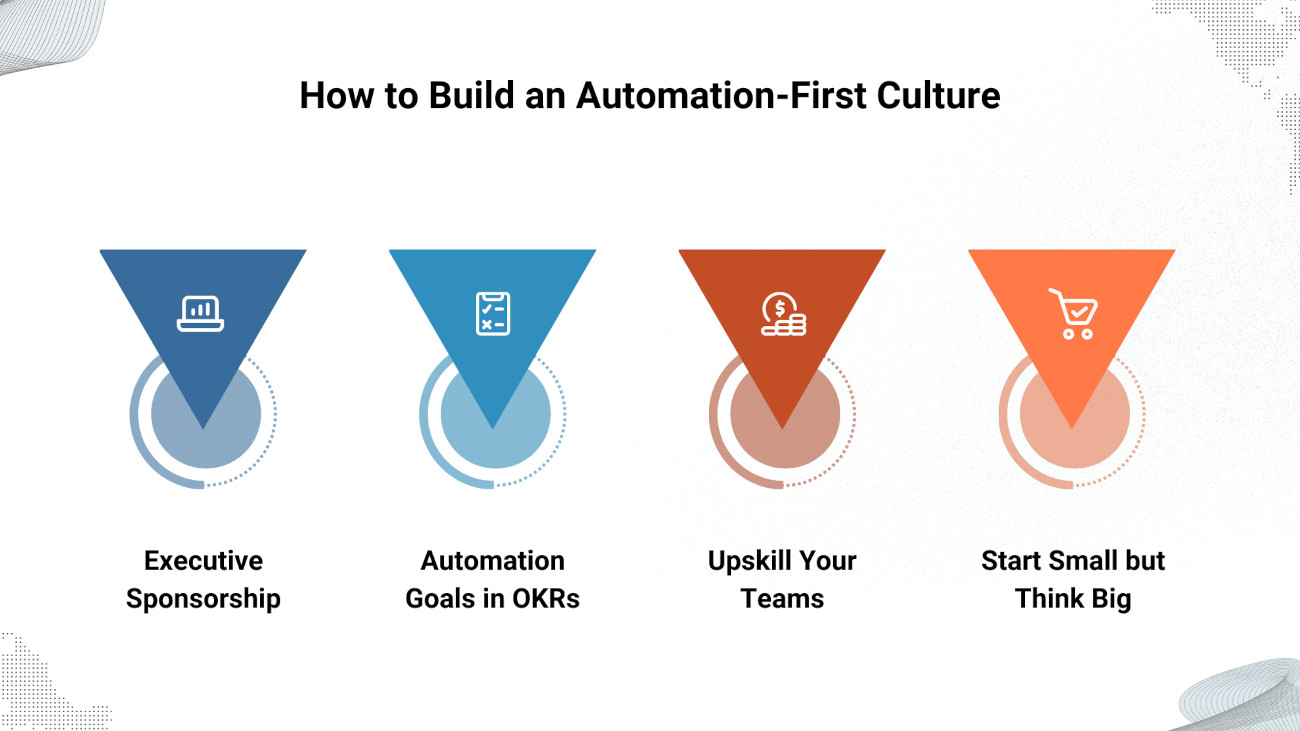
Step 2: Secure Leadership Sponsorship
- Present a clear business case: e.g., “By automating X process, we free Y hours of manual work, reduce Z errors, and improve experience for new joiners.” Celigo+1
- Identify a senior executive who will champion the effort, someone who can remove obstacles and influence culture.
- Scenario: The CHRO (Chief Human Resources Officer) commits to being the “Sponsor” for automation in PeopleOps, making it part of the HR strategy and budget.
Step 3: Build Cross-Functional Collaboration
- Bring together business process owners (e.g., HR, Finance, Ops) and IT/automation teams. This bridges silos and ensures process knowledge + technical feasibility align. UiPath+1
- Set up an “Automation Council” or community of practice that includes representatives from different functions. They will share ideas, coordinate priorities, and govern standards.
Step 4: Identify and Prioritise Automation Opportunities
- Use criteria such as: high volume, repetitive tasks, rule-based, well-defined inputs/outputs, measurable benefits. arXiv+1
- Pick some “quick wins” to generate momentum. For example: automating expense claim approvals, or employee onboarding notifications. Celigo
- Scenario: PeopleOps team identifies that early-stage new-hire provisioning is highly manual. They choose to automate form submission, account creation, and access assignment first.
Step 5: Define Governance, Standards & Metrics
- Establish standards for automation: how to document processes, how to test, how to deploy, maintain and monitor. Red Hat+1
- Define metrics: e.g., number of automated workflows, time saved, error reduction, employee satisfaction, ROI.
- Create a feedback loop: monitor what’s working, gather insights, iterate.
Step 6: Empower & Upskill Your Teams
- Invest in training: business users should feel empowered to identify automation opportunities; tech users should build automation competently. Red Hat+1
- Encourage an automation mindset across the organisation: everyone learns to “think automation first”.
- Scenario: Set up monthly “automation hackathons” where PeopleOps staff propose automation ideas, work with IT to prototype them, and share in a showcase.
Step 7: Scale and Institutionalise
- After early successes, use lessons learned to scale automation across more functions.
- Continuous improvement: automation isn’t “once and done”. The culture demands ongoing review, optimisation and innovation. community.automationanywhere.com
- Scenario: The PeopleOps team sees that onboarding automation freed 80% of manual time. They decide next to automate offboarding, performance review scheduling and learning-tracker notifications.
Step 8: Reinforce the Culture
- Celebrate wins: publicise automation successes, share testimonials of how employees’ work has improved.
- Align incentives: recognise teams that identify and implement automations.
- Embed automation thinking in everyday meetings: include “what can we automate?” as a standing agenda item.
- Scenario: At every PeopleOps leadership meeting, the first slide shows “Automation Opportunities” and the question posed is “What manual step in our process should we automate next?”
Real-World Scenario: Automation in PeopleOps
Let’s walk through a concrete example highlighting how this plays out in a PeopleOps context.
Challenge:
At a mid-sized tech company, onboarding new employees involved ~15 manual steps: creating IT accounts, assigning tools, sending welcome emails, setting up training, adding to payroll, etc. The average onboarding time was 7 days and managers were frustrated by delays.
Solution Approach:
- Step 1 & 2: PeopleOps leadership secured buy-in from the CHRO and CIO, connected the goal to “improve new-hire experience & reduce time to productivity.”
- Step 3: A cross-functional team of HR (PeopleOps), IT, and Operations mapped the onboarding process end-to-end.
- Step 4: They identified the “account provisioning” and “tool assignment” tasks as high-volume and rule-based, ideal automation targets.
- Step 5: They defined metrics: onboarding duration, manual hours saved, first-week satisfaction by new hires.
- Step 6: They trained a “citizen automation” team in PeopleOps so business users could propose workflow automations in a low-code tool.
- Implementation: The provisioning process was automated so that once the offer is accepted, triggers create accounts, send welcome packs, schedule IT orientation all happening automatically.
- Outcome: Onboarding time dropped to 1 day, manual hours per new-hire dropped by ~70 %. Employee satisfaction improved.
- Step 7 & 8: The team scaled automation to offboarding and internal transfers, held monthly “automation idea” workshops, and celebrated teams who made contributions.
This scenario shows how business, technical and process dimensions combine and how culture plays the essential role.
How PeopleOps Can Help You Build the Culture
At PeopleOps, our focus is on helping you not just deploy tools, but change mindset and setup sustainable ways of working. Here’s how we partner with organisations:
- Strategy & Roadmap Workshops: We help you define your automation vision, identify key business outcomes, and build a phased rollout plan.
- Governance Frameworks: We provide governance templates, metrics dashboards, standards for documentation, testing and deployment.
- Training & Change Management: We deliver upskilling for both business and IT teams, and support change-management to shift culture.
- Automation-Opportunity Identification: We help you run discovery sessions to spot high-impact use-cases in HR, Finance, Ops, Customer Service.
- Implementation Support & Coaching: We work alongside your teams in early automation runs to ensure operational success and take-away learnings for scaling.
- Tracking & Reporting Success: We set up metrics, dashboards and storytelling around wins to build momentum and keep culture moving forward.
Key Takeaways
- Building an automation-first culture is about mindset and method, not just technology.
- Without leadership, governance and a cross-functional approach, automation often remains siloed or fails to scale.
- Start small with high-impact, rule-based processes to build credibility and momentum.
- Empower your people: automation is everyone’s business (not just IT).
- Measure, celebrate and iterate: culture builds through proof points, stories and shared success.
- In a PeopleOps context, this means leveraging your HR and Ops processes as strong candidates for automation, improving both internal operations and employee experience.
Final Thought
An automation-first culture is not about replacing people, it’s about freeing people to do more meaningful, strategic work. By treating automation as a core organisational capability, you position your company for better productivity, faster responsiveness, and a more engaging workplace.
If you’re ready to embark on this journey, PeopleOps is here to guide you, from strategy to execution to cultural transformation.
Leave a Reply