


Introduction
We’re living in an era where automation, artificial intelligence (AI), and machine-learning systems are transforming how work gets done. For business leaders and PeopleOps professionals, the question is not just “Will machines replace people?” but “How do we ensure our workforce keeps pace?”
In this blog we’ll explore:
- What reskilling and upskilling really mean.
- Why they matter now more than ever.
- The common pain-points organisations face.
- How PeopleOps teams can lead the charge with real-world examples.
- A roadmap for putting a successful program in place.
What are Reskilling and Upskilling?
Before diving further, let’s clarify the two terms often used interchangeably but they are distinct.
Upskilling
Upskilling means enhancing the skills of existing employees so they can perform their current roles more effectively or take on increased responsibilities. For instance: a customer-service agent learning analytics tools so they can interpret customer data.
Reskilling
Reskilling means training employees to shift into a different role or function within the organisation or industry. For example: a manufacturing line operator being trained to monitor and operate robotic systems.
In short, upskilling = deepen/expand existing role; reskilling = transition to a new role. Wikipedia
From a PeopleOps lens, both are vital: one helps retain talent and boost performance; the other protects the organisation from gaps as roles evolve.
Why This Matters Now: Automation & the Skills Shift
The forces at play
- We are in the era of the Fourth Industrial Revolution (Industry 4.0), characterised by robotics, IoT, AI-driven systems, digital platforms. Wikipedia+1
- According to the World Economic Forum (WEF) Future of Jobs Report 2025, on average 39% of existing skill-sets are expected to become outdated or transformed in the period 2025-2030. World Economic Forum+1
- At the same time, 77% of employers say they plan to upskill workers explicitly in response to AI disruption. Beamery+1
- In many industries, automation is helping with efficiency (for example some reports show 15-20% savings in HR tasks through automation). Aura Blog
The implications
- Skills gap risk: If organisations don’t act, they may face talent shortages or mismatch between skills and the technology in use.
- Displacement + reinvention: Some roles with high automation potential may fade or shift; new roles emerge requiring different competencies. For example, while tasks may be automated, human skills like critical thinking, collaboration, leadership become more valuable. National University+1
- Opportunity for competitive advantage: Companies who proactively reskill/upskill can use their workforce as a differentiator in a tech-driven environment.
Real-world scenario
Imagine a global manufacturing firm implementing advanced robotics and predictive-maintenance AI in its plants. Operators whose jobs were largely manual need to either upskill (e.g., work alongside robots, interpret sensor data) or reskill (move into roles like robot-maintenance technician or analytics assistant). If the PeopleOps team fails to manage this transition, the firm may end up with idle labour, higher turnover, or inability to fully leverage the new tech.
Common Pain-Points for Organisations & PeopleOps
1. Identifying the right skills to target
Many organisations struggle with what skills to invest in. Should it be technical (data science, cloud computing), or soft/human (resilience, flexibility, leadership)? The research suggests both are important. World Economic Forum+1
Pain point: Skills audit is weak or outdated; training programs don’t map to real business-needs.
2. Engagement and learning culture
Even when training is offered, employees may resist (time constraints, relevance doubts, fear of change).
Pain point: Low participation; training seen as “tick-box” rather than strategic.
3. Integration with business change
If automation is introduced, training must align with the change-management process. Training in isolation has limited impact.
Pain point: Training executed without linking to role redesign, workflows, performance metrics.
4. Measurability and ROI
How do you measure the impact of reskilling/upskilling? What metrics matter?
Pain point: Lack of data/tracking makes it difficult to justify investment or scale programs.
5. Equity and access
Reskilling/upskilling must reach all parts of the organisation (not just the “digital natives”).
Pain point: Older workers, frontline workers may be left behind; “digital divide” within workplace.
How PeopleOps Can Lead the Way, A Strategic Approach
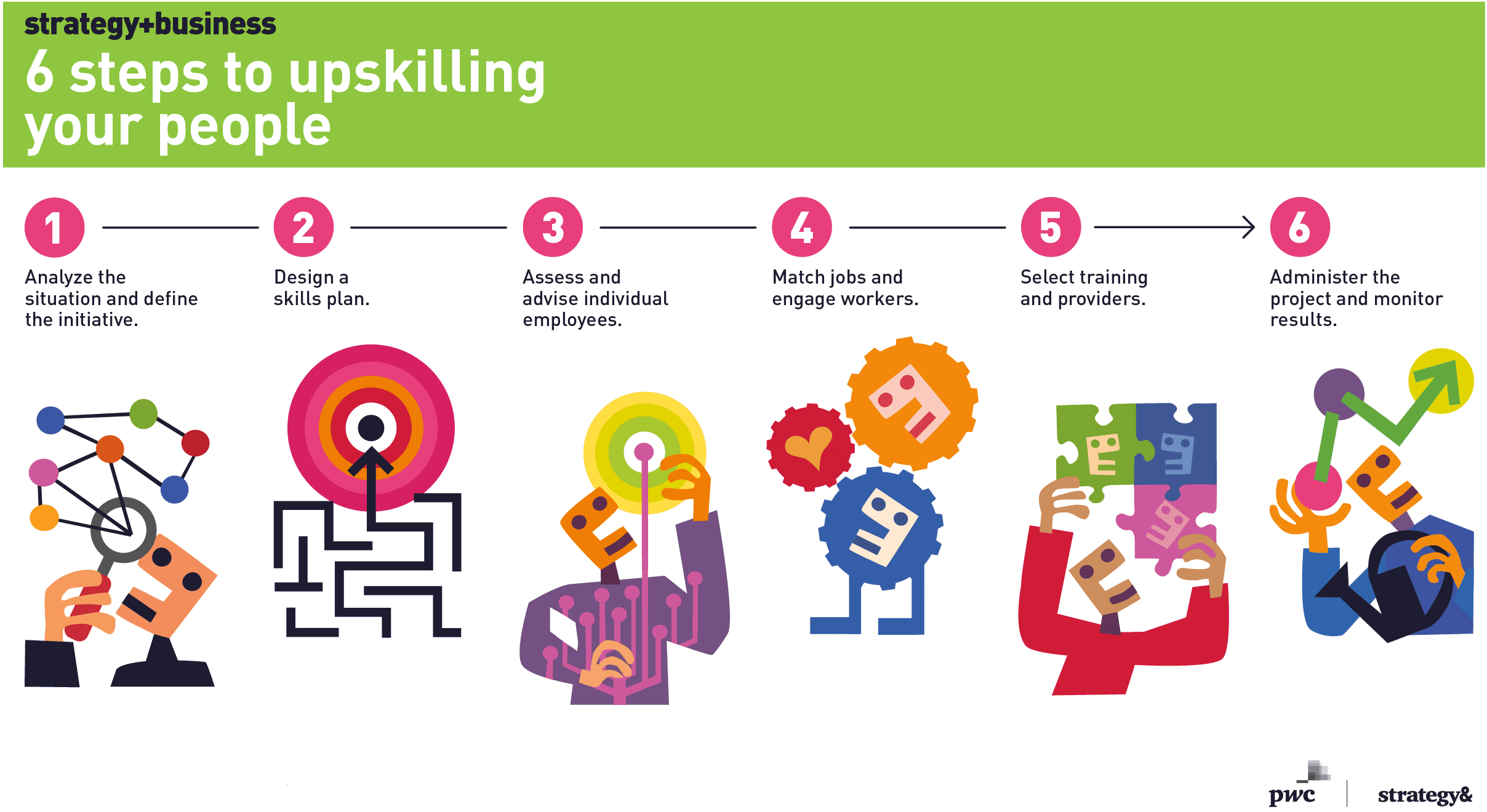
Here’s a roadmap for PeopleOps teams to design and deliver effective reskilling/upskilling initiatives.
Step 1: Perform a skills-gap and future-roles assessment
- Map current workforce skills (using surveys, audits, performance data).
- Forecast future roles & tasks in context of automation/AI rollout.
- Prioritise: Which roles are at risk? Which will grow?
For example, a service firm saw that 30% of administrative tasks would soon be automated by AI-bots; they mapped new “data-interpretation” roles to absorb those workers.
Step 2: Co-design learning pathways
- Develop upskilling tracks for staff who will remain in their roles but will adapt (e.g., digital literacy + data-fluency + collaboration).
- Develop reskilling tracks for those transitioning to new roles (e.g., job-shadowing, mentoring, formal certification).
- Combine technical and human (soft/durable) skills: e.g., adaptability, critical thinking, leadership. (Research shows these human/durable skills are rising in demand. National University)
- Use micro-learning, blended formats, on-the-job projects.
Step 3: Integrate with business processes
- Link training to actual job redesign, workflows, KPIs (so learning isn’t “out of context”).
- Embed mentorship, peer-learning, job assignments rather than purely classroom modules.
- Example: In a manufacturing plant adopting robotics, operators were paired with technicians and given gradual responsibility for robot-supervision, blending hands-on + formal training.
Step 4: Foster culture and communication
- Communicate why the change is happening (automation does not always mean layoffs, often means different skills).
- Emphasise growth, mobility, opportunity.
- Encourage a growth mindset, reskilling/upskilling as continuous journey.
- Remove stigma: Traversing to a new role is not “failure” but evolution.
Step 5: Track, measure, and iterate
- Define metrics: e.g., % of workforce trained, role-mobility rate, skill-gap reduction, productivity gains, retention improvements.
- Use data to identify programs that work (or don’t).
- Scale successful initiatives; retire or redesign ineffective ones.
For example: A retailer tracked that employees who took digital-analytics upskilling improved sales conversion by X% then scaled that program.
Step 6: Make it inclusive
- Provide flexible learning formats so frontline, shift-workers, older employees have access.
- Recognize and reward participation (certificates, role advancement).
- Ensure learning budgets cover all levels not just senior staff.
Role of PeopleOps in the Age of Automation
As PeopleOps professionals, you’re at the heart of enabling workforce transformation. Here are specific actions you can lead:
- Strategic partner: Work with business-leaders, tech teams, operations to align skills strategy with automation roadmap.
- Talent architect: Map out talent-pipelines, identify high-potential employees for reskilling, create mobility pathways.
- Learning-ecosystem designer: Select platforms, curate content, create communities of practice.
- Change agent: Drive communication, monitor cultural change, handle resistance, champion success stories.
- Data steward: Implement skills-inventory systems, track outcomes, dashboard results.
By doing so, PeopleOps shifts from “training manager” to “business-growth enabler”.
Challenges & How to Overcome Them
Here are a few common obstacles and suggested mitigations:
| Challenge | Mitigation |
|---|---|
| Employees view training as optional or low-priority | Link training completion to performance goals; create visible career pathways. |
| Rapid tech change makes skills strategies outdated quickly | Set shorter-cycle review of skills roadmap; involve tech/operations teams in regular refresh. |
| Hard to measure ROI | Define upfront what success looks like (e.g., role transition rate, productivity per employee, retention), collect baseline data. |
| Resistance from employees fearing job loss | Communicate transparently about role evolution; highlight success stories; emphasise human + tech collaboration. |
| Unequal access (shift-workers, remote staff) | Use mobile-first micro-learning; provide flexible scheduling; offer peer-learning groups. |
Why This Matters for Business and Employees
For the business
- Builds a future-ready workforce, aligned with automation strategy.
- Reduces risk of talent shortages or skills gaps, thus avoiding project delays or cost overruns.
- Boosts employee engagement, retention and internal mobility, saving cost of external hiring.
- Helps differentiate the company as an employer of choice, an important advantage in competitive markets.
For employees
- Provides career resilience in a rapidly shifting workplace.
- Offers growth and mobility not just lateral stagnation.
- Improves employability, both within current organisation and in the wider market.
- Helps mitigate the anxiety of automation, instead of replacement, the narrative is evolution.
A Short Case Study (Illustrative)
Let’s imagine “TechManufacture Ltd.”, a company in India that has just invested in advanced robotics across its production lines. The PeopleOps team recognised 30% of existing operator roles would evolve in the next two years (based on internal task-mapping + vendor predictions).
Action taken:
- Mapped all frontline roles with automation risk and created tier-1 (upskilling) and tier-2 (reskilling) pathways.
- For upskilling: Operators took courses in “Sensor Data Interpretation”, “Basic Robotics Maintenance”, and “Lean Problem Solving”.
- For reskilling: A group was given shadowing in “Robotics Maintenance Technician” role, supported with formal certification and mentorship.
- Business aligned workflows: production planners adjusted to include “robot-backup” roles, and performance metrics for operators shifted to “automation-supervision” tasks.
Results: Within 12 months, 85% of the targeted workforce had begun training; operators reported higher job satisfaction (since routine manual tasks reduced); the company reported less downtime due to operator error with new machines. Over time, this internal mobility reduced hiring cost for new technician roles.
Key Takeaways
- Automation is accelerating change in roles and skills, upskilling and reskilling are no longer optional.
- Reskilling ≠ just training for new tech. It’s about role transition, combining technical + human skills.
- Upskilling is equally critical: making employees better at what they already do, in a tech-enabled context.
- PeopleOps can and should drive this change: strategic, integrated, measurable, inclusive.
- Investing in this area benefits both the business (agility, talent, growth) and employees (career security, satisfaction).
- Start with a skills-audit, then build pathways, integrate with business change, measure outcomes, iterate.
Leave a Reply