

Introduction
In today’s fast-moving business world, the function of people management has evolved considerably. Where once HR (Human Resources) focused primarily on payroll, compliance and filling vacancies, the modern approach, often called People Operations (PeopleOps) shifts the focus to people as the heart of the organisation: their experience, growth, engagement and meaningful contribution. agilepeopleopsframework.com+1
At the same time, advances in technology, automation, artificial intelligence (AI), machine learning (ML), integration platforms—are enabling organizations to reduce the burden of repetitive tasks, digitize workflows and free up human time for more strategic, human-centric work.
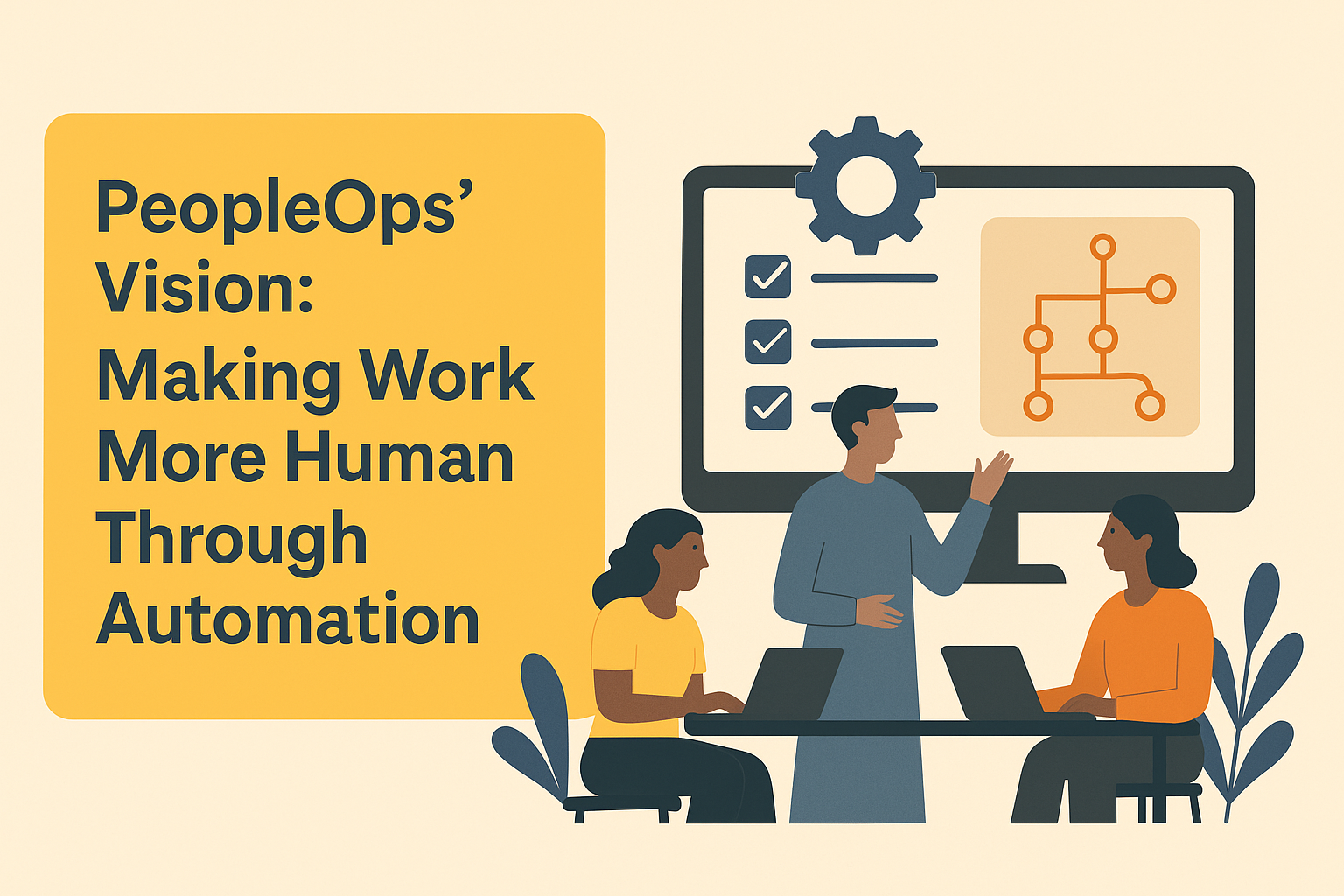
The vision of PeopleOps today is to make work more human through automation. In other words: use technology to remove friction, reduce administrative burden, streamline processes so that teams and individuals can focus more on what really matters: purpose, connection, growth, collaboration.
In this blog we’ll explore:
- What this vision means in practical terms
- The key pain points businesses face today in people operations
- How automation helps alleviate these pain points
- Real-world scenarios of how it plays out
- What organisations should keep in mind when adopting automation
- How PeopleOps teams can lead this change
Let’s dive in.
1. What “Making Work More Human” Means
“Making work more human” is a phrase you’ll hear more often, and it essentially means: creating an environment where people feel valued, engaged, empowered, and where their day-to-day work is meaningful rather than bogged down by administrative burdens. Key elements:
- Employee experience is central: from onboarding to exit, every touchpoint matters.
- Engagement, development and wellbeing are not peripheral but integral to success.
- Human time (mentoring, coaching, culture building, collaboration) is elevated; mundane tasks are minimised.
- Systems and processes support rather than hinder people.
- Data & insights are used to proactively support people not just retroactively measure them.
When you pair that with automation, you get a formula like: “Let machines handle the repetitive, let humans handle the meaningful.” Automation becomes an enabler of humanity, not a replacement.
2. Key Pain-Points in PeopleOps & Why They Matter
Here are some of the recurring problems organisations face in people operations today:
- Manual, repetitive tasks that consume time
For example: onboarding paperwork, account provisioning, payroll data entry, leave approvals. These tasks eat up hours that could be spent on connection, coaching, or strategy. - Disconnected systems and data silos
Employee data in one system, benefits in another, performance in yet another. This slows down processes, creates inconsistency and weakens the employee experience. According to a source, automating onboarding and off-boarding via connected systems is a major impact area. Celigo+1 - Slow response to employees’ routine needs
HR service desks may receive many repetitive queries (e.g., “How many leaves do I have?”, “What’s the policy for remote work?”). Slow responses frustrate employees, reduce trust. - Poor quality of experience in critical transitions (onboarding / offboarding)
First impressions count. If onboarding is chaotic, delayed systems, overlooked training, unclear roles, it sets a negative tone. - Limited time for strategic people work
If PeopleOps teams are locked in administering rather than enabling, they cannot focus on culture, growth, retention. - Risk and compliance burden
Manual processes can result in errors or delays in compliance (labor laws, data privacy) which increase risk. Automation helps here too. Celigo+1 - Employee wellbeing & change fatigue
As automation and AI become more prevalent, employees may feel insecure or “replaced”. Research shows that while automation brings efficiency, concerns about job security, fairness and transparency become more significant. arXiv
These pain-points matter because they affect both the business (costs, speed, risk) and the people (experience, engagement, retention). When PeopleOps gets stuck in “busy work”, the opportunity to make work more human slips away.
3. How Automation Enables the Vision
Here’s how automation plays a role in making work more human by addressing the above pain-points:
• Streamlined Onboarding & Offboarding
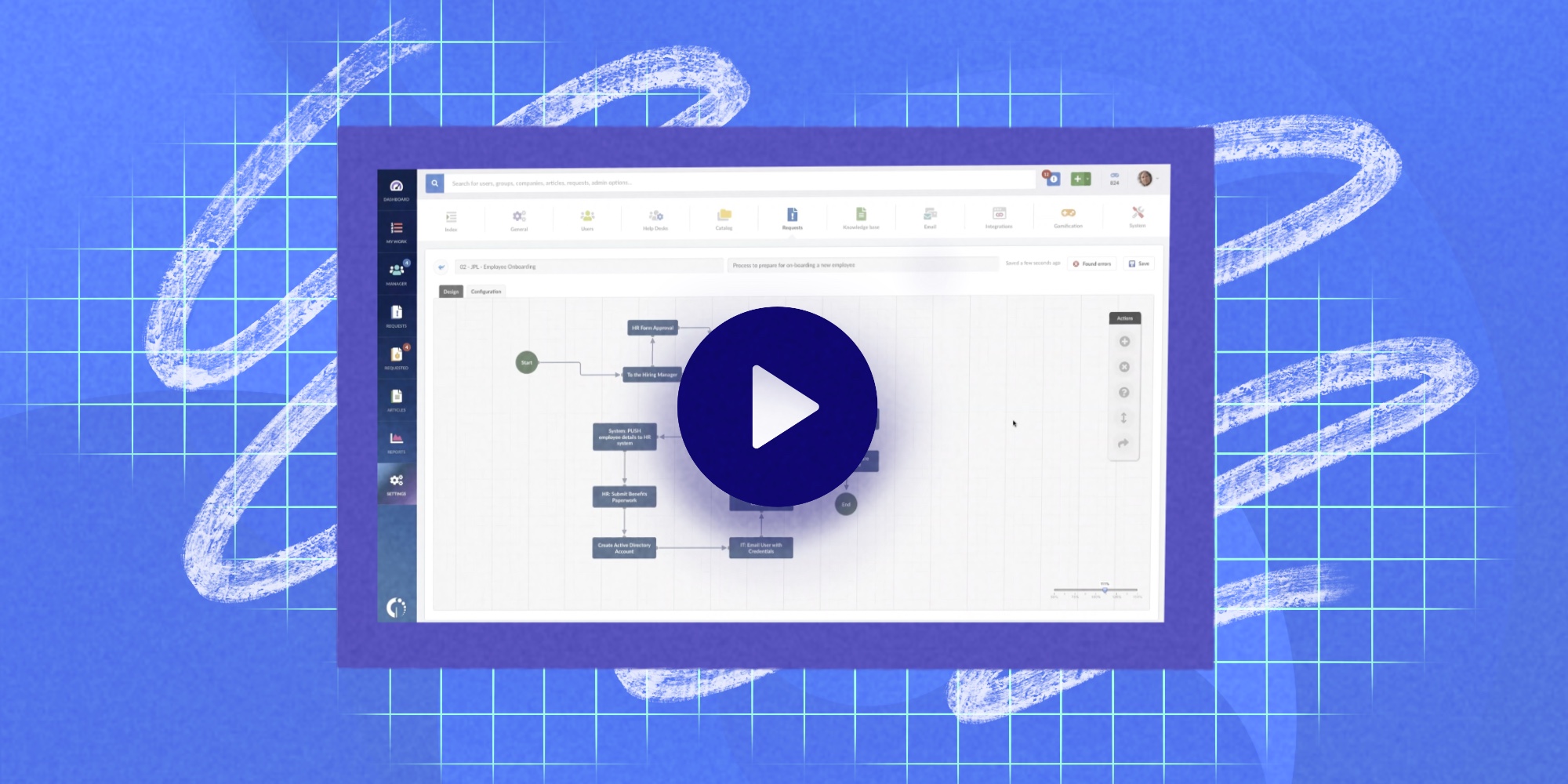
Automation platforms connect HRIS/ATS, IT systems, access provisioning and training, so that when a new hire joins: account set-up, equipment provisioning, training schedules, buddy assignments happen seamlessly. Offboarding likewise sees assets deprovisioned, access removed, exit interviews triggered, reducing risk and improving experience. One integration-platform provider cites “employee onboarding & offboarding” as a key use-case. Celigo
• Self-Service + Employee-Centric Interfaces
Employees can access leave balances, request time-off, view benefits, update personal details, ask HR questions via chatbots/portals, freeing the PeopleOps team to focus on higher value work. This also empowers employees, which is more human-centred.
• Automation of Routine HR Workflows
Time-offs, expense approvals, performance review reminders, training assignment, policy acknowledgements, all can be automated. This reduces latency, errors, cost, while improving consistency. The benefit: PeopleOps team can coach rather than chase forms. bgboco.com
• Data & Integration for Insight, Not Just Admin
When systems are integrated via automation, PeopleOps get clean data: attrition trends, engagement signals, skills gaps. This enables proactive strategic work: e.g., identify retention risk, launch development programmes, monitor culture. The “people as internal customers” mindset is supported. agilepeopleopsframework.com
• Improved Employee Experience & Agility
When you reduce delays, reduce friction, give employees the tools they need, the whole experience improves. Culture and human connection become the focus, not paperwork. Businesses become more agile.
• Risk Mitigation and Compliance Through Automation
Automation can trigger alerts, ensure policy changes are acknowledged, employee data is updated, off-boarding is handled correctly. This reduces risk and frees up PeopleOps to drive culture rather than chase compliance issues.
In summary: Automation is not about replacing humans, it’s about elevating humans. It’s about freeing PeopleOps to focus on humanity in work, not administration.
4. Real-World Scenarios
Let’s look at a few real-world style scenarios illustrating how this plays out in practice.
Scenario A: New Hire Surprise
Imagine a fast-growing SaaS company in Pune that hires 20 engineers in a month. Without automation: HR team spends days provisioning access, arranging equipment, scheduling inductions, chasing signatures. The result: some hires have to wait for laptop, lack clarity on buddy, feel disengaged.
With automation: On system trigger (hire accepted) the PeopleOps automation workflow starts: IT provisioning, welcome kit delivery, buddy system configured, calendar invitations sent, mandatory training queued. The new hire’s first day is smooth, they feel welcomed and can start contributing fast. The PeopleOps team uses the time saved to do a “welcome call” and connect the person with a mentor and focus on the human connection, not form-filling.
Scenario B: Employee Query Relief
An employee wants to know: “How many leaves do I have? Can I work from home this Friday? What’s the policy on partial day?” In many organisations this means a HR ticket, back-and-forth emails, delay.
With automation/self-service: The employee asks via chat-bot (or portal) which pulls data real-time, gives the answer, optionally escalates to a human for complex scenario. PeopleOps team only intervenes when there’s nuance. The result: faster service, better experience, less stress for HR.
Scenario C: Retention & Engagement
A mid-sized company sees rising voluntary turnover among mid-career engineers. PeopleOps uses analytics from integrated systems (HRIS + engagement survey + training completion) and finds a pattern: engineering team with fewer growth conversations, low training uptake, high SKUs. They automate reminder workflows for “career check-in”, link to internal mobility portal, assign mentoring. Over time retention improves. Because the data flows easily and the automation triggered conversations rather than just admin.
Scenario D: Compliance and Rapid Scale
A global organisation with multiple locations (India, US, Europe) must ensure local labour policies, off-boarding, access revocation, asset recovery are done reliably. Manual processes are error-prone and risky. Automation workflows enforce policy checks, audit trails, timely off-boarding tasks, and surface exceptions to PeopleOps for decision rather than let things slip. Culture of reliability supports human trust.
5. What Organisations Should Keep in Mind (Best Practices)
Even though automation offers a lot of benefits, having the right mindset and implementation approach is critical. Here are some key guidelines:
a) Start With People, Not Tech
Automation should serve the people strategy, not the other way round. Ask: “What human problem are we solving?” before implementing tools. If you automate a bad process, you simply get a bad automated process.
b) Select the Right Processes
Don’t attempt to automate everything at once. Start with high-impact, repetitive, error-prone processes (like onboarding, leave approval, service desk queries). Many HR/PeopleOps automation guides emphasise starting small. bgboco.com
c) Ensure Data Integrity & Integration
Automation thrives on clean, connected data. Disconnected systems will still lead to manual interventions. Integration platforms (like the one cited above) show the value of connected systems in PeopleOps. Celigo
d) Maintain the “Human” Touch
Automation should handle the routine but you must preserve the uniquely human parts: empathy, mentoring, leadership, culture-building, career conversations. Also recognise the wellbeing and psychological impact of automation: research shows that poorly implemented AI/automation can lead to feelings of insecurity, lack of transparency and reduced trust. arXiv
e) Communicate Transparently & Involve Employees
When you introduce automation (especially with AI), oversharing or lack of clarity can breed suspicion. Be transparent about what automation will do, how it affects roles, how employees will benefit. Involve them in design and provide upskilling if needed.
f) Measure Success, Not Just Efficiency
Yes, automation saves time and cost but measure the impact on employee experience, engagement, retention, speed of service, quality of onboarding. For PeopleOps, these human metrics matter as much as operational ones.
g) Ensure Ethics, Fairness & Governance
If you use AI/ML (for example, for recruiting, performance analytics), ensure fairness, avoid bias, ensure privacy and transparency. The human dimension is especially important here.
h) Continuous Improvement
Processes, roles, systems evolve. Automation is not “set and forget”. Regular review, feedback loops, adjustments are essential. Research on human-centred design of automation emphasises participatory design and continuous iteration. arXiv
6. How PeopleOps Teams Can Lead This Change
If you’re a PeopleOps professional (or aspiring to be), here are steps you can lead to embed this vision of making work more human through automation:
- Build a vision and narrative: Articulate how automation helps the organisation’s people and culture, not just cost-cutting.
- Map the employee lifecycle and pain points: From recruitment to exit, identify where the people experience falters and where automation can relieve load.
- Partner with Technology/IT: Automation often lives at the intersection of PeopleOps and IT. Joint governance is essential.
- Pilot small but meaningful workflows: Choose one high-impact area (e.g., onboarding) to pilot, learn, refine.
- Design for the user (employee) experience: Map journeys, include employee touchpoints, ensure the self-service/automation blend is intuitive.
- Ensure the human-automation balance: Keep humans in the loop for decision-making, empathy, exceptions. Automation should enhance humans, not bypass them.
- Gather metrics and feedback: After implementation track both operational metrics (e.g., time to onboard) and human metrics (e.g., new hire satisfaction).
- Drive change management and culture: Automation changes how work gets done. Communicate, train, set expectations.
- Foster continuous learning and upskilling: As the role of PeopleOps evolves (less admin, more strategic & human-centric), ensure your team and employees are ready for that shift.
- Stay informed about ethics & governance: With AI/analytics more common in HR/PeopleOps, you’ll need to ensure fairness, transparency and trust.
Conclusion
In essence, the vision of PeopleOps today is compelling: it is to make work more human through automation. By removing the administrative burden, ensuring seamless processes, empowering employees with self-service, connecting data, and freeing PeopleOps to focus on culture, growth, experience and strategy, we shift from “managing resources” to “enabling people”.
Automation is not the enemy of humanity in work; when done right, it becomes a tool for humanity. It enables PeopleOps teams to spend less time on paperwork and more time on purpose. It enables organisations to deliver faster, better, with integrity and care. And it enables employees to feel seen, supported and engaged, not stuck in forms and queries.
As business leaders, PeopleOps professionals and technologists, our challenge is to align technology with human purpose. To ensure that behind every automation workflow is a person whose experience matters. To build systems that support individuals, teams and organisations—and to do so in a way that is ethical, transparent and centred on the human.
If you’re ready to explore how your organisation can bring this vision to life, how you can automate the right things so your people can do the right things, then you’re stepping into the world of modern PeopleOps. Let’s make work more human together.
Leave a Reply