Introduction


In today’s agile and fast-moving business world, one thing stands between success and surprise: real-time visibility. Especially in project-based work, when budgets are large and scope is complex, the difference between staying on track and a six-figure cost overrun often comes down to how early one spots the signs of risk.
In this blog, we’ll explore how a team used real-time tracking of their Work In Progress (WIP) to identify a looming six-figure overrun and course-correct before it got out of control. We’ll talk about the underlying pain-points, the practical scenario, how people-operations (PeopleOps) + project controls stepped in, and what your organisation can learn.
The Problem: Why Overruns Happen
Even with good intentions and smart teams, overruns are common. Research shows that many projects exceed budgets by 15-25% (or more) because of poor estimation, scope creep, delays, and lack of visibility. Master of Project Academy Blog+2onekeyresources.milwaukeetool.com+2
Here are some of the typical pain-points for organisations (both technical and business stakeholders will recognise these):
- Delayed cost recognition: An expense is incurred but not logged promptly, so the reported “remaining budget” is optimistic.
- Lack of real-time scope tracking: Work is being done, but the status or completeness is not captured until later, meaning surprises accumulate.
- Disconnected dashboards: Finance, operations, project teams are using different tools/data, leading to “we think we’re under budget” while actuals are running ahead.
- Reactive rather than proactive controls: By the time a budget warning appears, many corrective options are already ineffective.
- Poor forecasting and WIP control: Without accurate WIP (work in progress) tracking, you may not realise you’ve used 70% of the budget for only 30% of the work. (This is pointed out in construction accounting literature.) Deltek+1
When these align, you end up with a scenario where a project that seemed fine suddenly requires hundreds of thousands of dollars more to complete, or worse, suffers quality or timing issues.
A Real-World Scenario: Six-Figure Overrun Averted
The Setup
A mid-sized engineering consultancy firm won a contract to deliver a modular software integration project for a large enterprise client. Total contract value: US $750,000. Estimated cost (internal) for the team: US $550,000 across labour, subcontract, tools, and overhead.
The project started well. Milestones were met in the early phase. But underneath the surface, work was progressing faster than logged, spend was creeping ahead, and the internal tracking was lagging.
Where things got risky
- The team had completed only ~40 % of the major modules, yet cost tracking showed ~65 % of the budget had been committed or spent (labour + subcontractors + tools).
- Because of the delay in capturing actuals and the team focusing on execution, the WIP schedule had not been updated in real-time.
- The PeopleOps / project controls team only reviewed the WIP weekly (not daily), and the dashboard would refresh end-of-week, meaning the overspend trend had built up.
- At that point, without intervention, the projected cost to complete would require an additional US $120,000 beyond budget (~+22%), a true six-figure overrun risk.
The Turning Point: Real-Time Visibility
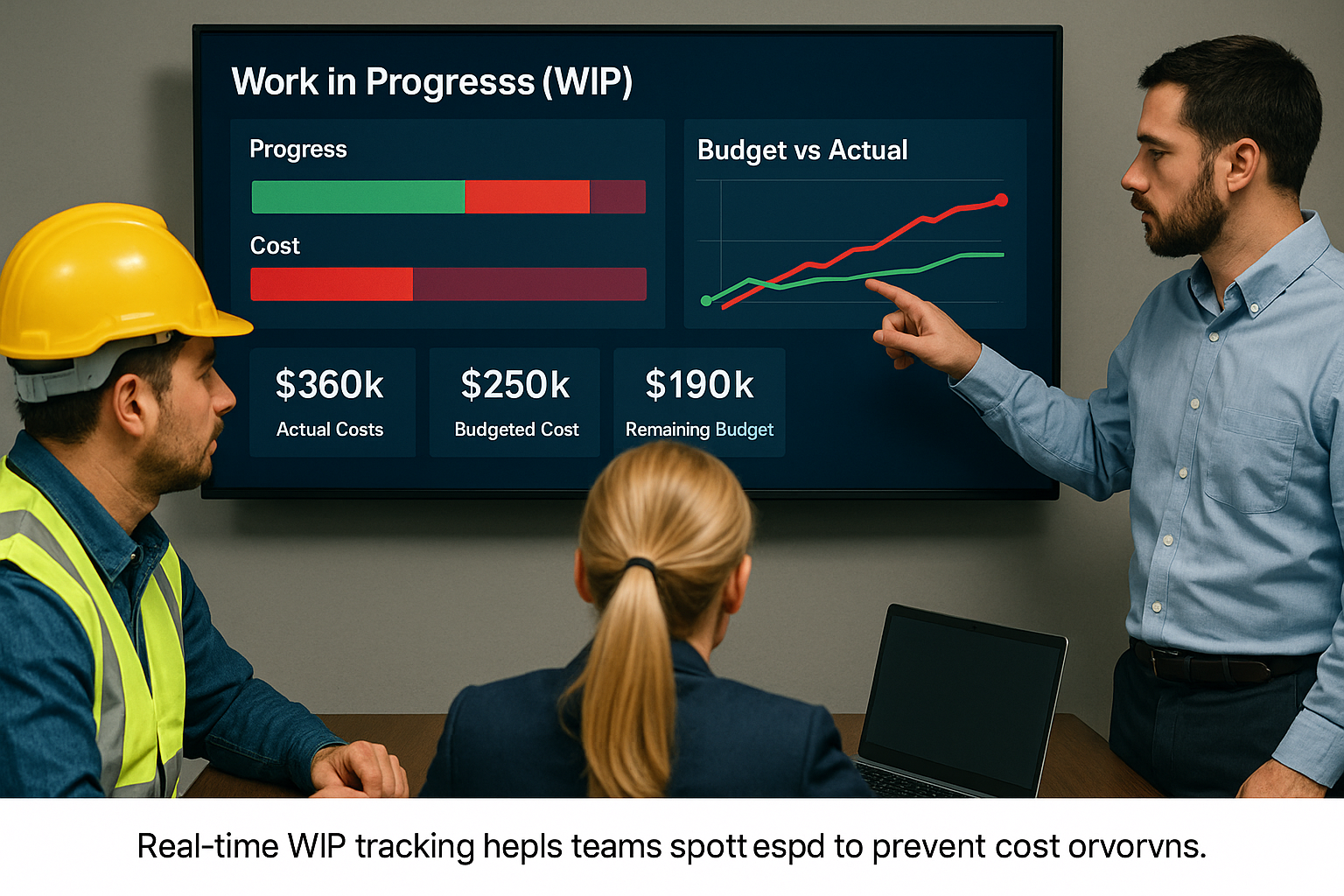
At a weekly status review, the project controller flagged a red-zone: cost incurred to date vs work completed were diverging. The real-time WIP dashboard showed:
- Actual costs to date: US $360k
- Budgeted cost for this phase: US $250k
- Remaining budget: US $190k
- Estimated cost to complete based on burn-rate: US $310k
When the PeopleOps partner asked the project manager, it surfaced that subcontractors were working ahead of schedule (good), but the billing and time capture had not been aligned (bad). The team was doing more work than planned without fully capturing scope changes, rate adjustments, or downstream integration costs.
Intervention
The organisation took three swift measures:
- Daily WIP updates: The dashboard was shifted from weekly to daily refresh; time-capture and subcontractor invoices had to be entered within 24 hours.
- Scope- vs-Cost Re-Baseline: They ran a mini-forecast for completion cost (cost-to-finish method) and adjusted future spend and resource allocation accordingly.
- Change-Control Enforcement: Any scope deviation going forward required a formal review (PeopleOps + project controls) before subcontractor engagement or tool purchase.
Outcome
Because the trend was caught in time, the team avoided the overrun. They closed the project at ~US $540,000 cost (below original estimate) while delivering the full functional scope. The six-figure overrun did not materialise. The business unit (with PeopleOps support) learned to link real-time WIP tracking to resource allocation and subcontractor management.
How PeopleOps (And Project Controls) Helped


From a PeopleOps perspective (which often sits at the intersection of resource, process and analytics), this scenario highlights how PeopleOps can actively act as gate-keeper and integrator between project teams, finance, and operations. Here’s how:
- Data integration & visibility: PeopleOps ensures that the project cost, resource utilisation, subcontractor spend, time-capture data feed into a unified WIP dashboard. This breaks down silos so business stakeholders can see the “true state” in near real-time.
- Resource & subcontractor governance: When subcontractors were being engaged ahead of formal scope/approval, PeopleOps helped enforce the change-control process, making sure human capital cost + subcontract cost were budgeted.
- Early warning triggers: PeopleOps defined trigger thresholds (for example: actual cost > 60% of budget while %-complete < 50%) and set automatic alerts. This made the “red zone” visible before escalation.
- Cross-functional alignment: Between operations, finance and HR (PeopleOps), they aligned the narrative: “yes we are ahead on work, but are we ahead on cost capture and risk?” This alignment helped avoid blame/hide cycles.
- Learning & process improvement: After the project, PeopleOps facilitated a retrospective where the team examined why WIP data lagged, what process delays existed (time-capture, invoice entry), and embedded the improvement into the next project.
Key Takeaways & Best Practices
Here are some actionable lessons you can apply in your organisation to ensure you catch WIP issues early and avoid large overruns:
- Track WIP in real-time (or as close as possible)
Organisations that rely on weekly or monthly updates often miss leading indicators. Real-time or daily dashboards give faster visibility. Outbuild+1 - Compare cost incurred vs work completed
It’s not enough to track spend alone. You must compare actual cost to %complete to identify divergence (for example, 60% cost spent but only 30% complete). Deltek - Use cost-to-finish forecasting
Rather than just looking at past spend, forecast what it will cost to complete the remaining work. This helps identify future overruns early. Complete Controller - Define trigger thresholds and alerts
Set up trigger conditions: e.g., cost burn rate > X% vs budget, resource hours > Y vs plan, scope creep events > Z. These triggers help you act early. - Enforce change-control tightly
When work changes (scope, subcontractor, tool purchase), capture that formally, update WIP estimates, and adjust budget/resource accordingly. - Integrate stakeholders (finance + ops + HR/PeopleOps)
Siloed teams create blind spots. When finance, operations, and PeopleOps speak the same WIP language, risk gets surfaced earlier. - Embed learning & process improvement
After each project, review what caused the WIP tracking lag (time-capture delay, invoice processing, manual reporting) and fix for next time.
Summary
A six-figure overrun almost happened but didn’t. Because the team had early enough warning via a real-time WIP dashboard, the intervention stopped cost escalation while there was still action space. For PeopleOps and project teams, the lesson is clear: data-driven visibility + governance + process discipline = avoiding budget shocks.
If your organisation is still relying on end-of-week/month WIP snapshots, or spend data that lags by days/weeks, you may be at risk of hidden overruns. The good news: the remedy is straightforward: improve your WIP visibility, integrate it into your daily rhythm, and align your teams.
Leave a Reply