
Automation has been a staple of business operations for decades, think rule‐based workflows, repetitive tasks handled by software, robotics in manufacturing, and so forth. But in recent years, something bigger has arrived: the rise of advanced artificial intelligence (AI) that is transforming traditional business automation into something far more dynamic, adaptive and intelligent.
In this article (written for both business and technical readers), we’ll walk through:
- what traditional automation looks like, and the pain points it has
- how AI changes the game and the new capabilities it brings
- real‐world scenarios illustrating the shift
- key challenges & people/ops implications (since you are writing for PeopleOps)
- how PeopleOps functions must adapt to leverage AI‐driven automation
- a brief roadmap for organisations thinking of making the shift
1. What “traditional” business automation means (and what’s wrong with it)
Historically, business process automation meant using software, robotic process automation (RPA), scripts or hard‐coded workflows to handle predictable, repeatable tasks. Examples include:
- invoice approvals, expense reimbursements, payroll processing
- moving data from one system to another, populating forms, generating standard reports
- manufacturing assembly line automation controlled by PLCs and robots
- basic customer service chatbots that follow rigid decision trees
While these tools delivered benefits (fewer errors, faster processing, cost‐savings), they also came with limitations:
- Rigid rule‐based logic: They cannot deal well with exceptions, changing conditions, unstructured data.
- High maintenance: Every time the process or data changes, scripts or flows must be updated.
- Limited intelligence: They don’t “learn” from experience or adapt to new patterns.
- Focus on cost savings, not strategic value: Many automations simply replace human labour rather than augment higher‐value work.
- People & change issues: Automation rolled out as “we’ll replace your tasks” can create resistance, skill‐gaps, or messy handoffs to humans when things go wrong.
In short: traditional automation is effective for known, structured, repetitive tasks, but less so when processes are complex, dynamic, or involve unstructured inputs (e.g., emails, images, human decisions).
2. What AI brings to automation, the new capabilities
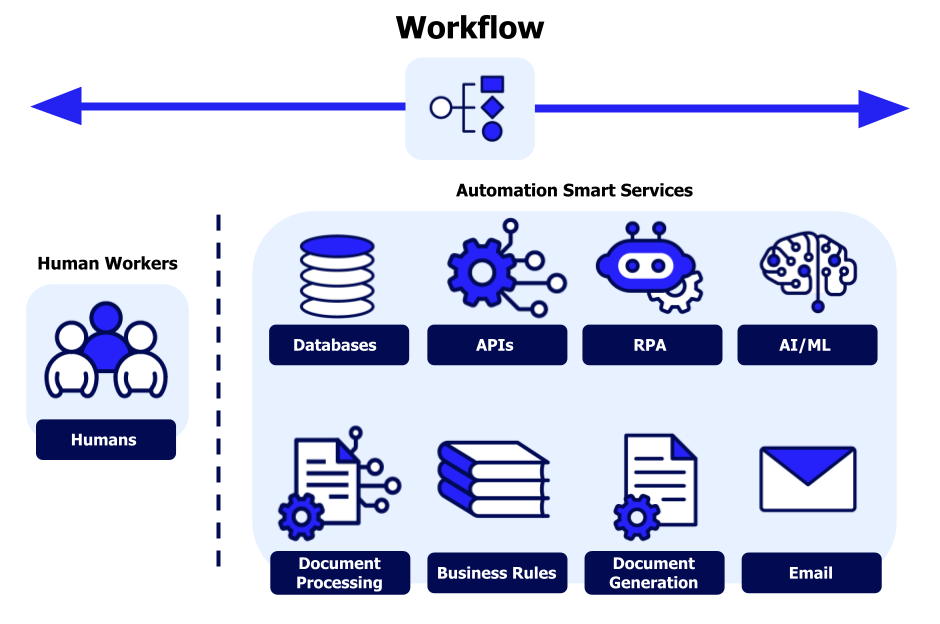
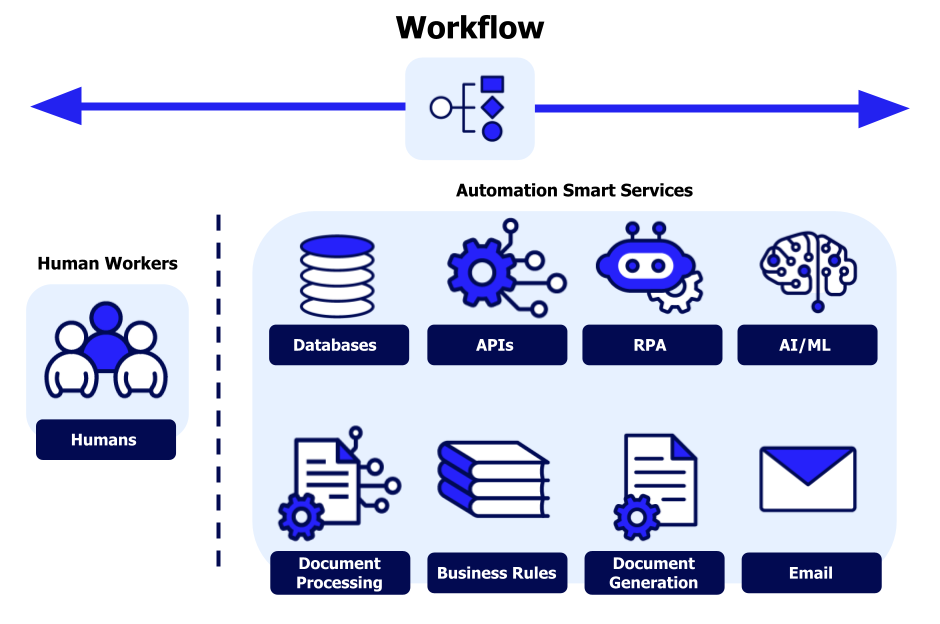
This is the part where things get interesting. By embedding AI into automation, organisations are moving from “automate‐what‐we‐know” to “automate and optimise what we learn”. Here are some of the major shifts:
a) From rule‐based to learning & adaptive
- With ML (machine learning) algorithms, systems can analyse historical process data to predict outcomes, identify patterns, and adapt decision logic rather than just follow fixed rules. Boomi+2iSchool | Syracuse University+2
- For example, instead of a static “if invoice > $10 k escalate to manager”, an AI can learn from past exceptions, actual approvals, and trigger different flows depending on context.
b) Handling unstructured data
- Traditional automations struggled with emails, free‐text fields, images, voice recordings. With AI (e.g., NLP = natural language processing, computer vision), automation workflows can now ingest and interpret these types of data. Boomi+1
- For example: chat logs converted to actionable items, scanning handwritten forms, analysing customer voice calls for intent.
c) Agentic and generative capabilities
- Beyond automation of tasks, AI is now creating content, generating code, designing workflows, even acting as “digital colleagues”. According to an industry article: “Generative AI turns manual processes into fast, data-driven cycles.” Oracle+1
- The concept of AI agents (which can reason, plan and execute across systems) is also taking root. Boston Consulting Group+1
d) Greater value‐creation: strategic, not just operational
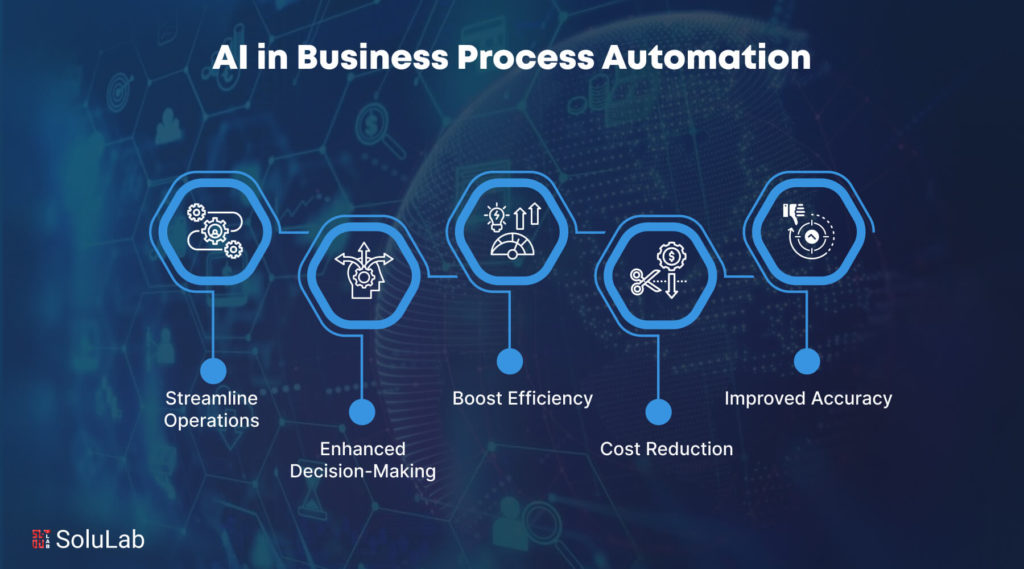
- With AI, automation is no longer only about cost‐savings, but about value generation: faster decision‐making, improved customer experiences, predictive maintenance, supply‐chain optimisation. McKinsey & Company+1
- Example: In manufacturing, AI+automation reduces downtime, predicts machine failures, and thus transforms performance—not just labour reduction. Rockwell Automation+1
e) Human-AI collaboration & workforce transformation
- AI doesn’t purely replace humans; increasingly the model is humans + AI (augmented workforce). For automation teams, this means designing workflows where AI handles the heavy lifting, humans handle exceptions, strategy, empathy. World Economic Forum+1
3. Real-world scenarios (from different functions)
Let’s bring this to life with a few applied examples (that also highlight PeopleOps implications).
Scenario 1: Finance & Expense Automation
A large enterprise deploys an AI‐enabled workflow for expense reimbursement:
- Employees upload receipts via mobile. The system uses computer vision + OCR to extract details.
- Machine learning models classify whether the expense is legitimate, flagged, or needs manager review (based on historical behaviour).
- A digital agent routes the claim automatically, triggers payment, and updates accounting systems.
- Over time the system “learns” exceptions (e.g., unusual business travel patterns) and routes accordingly.
Pain point addressed: High manual effort, slow reimbursements, high error rate, employee frustration.
PeopleOps impact: The finance team shifts from manual data entry to exception‐handling & strategic process improvement; training is required to trust the system & manage exceptions.
Scenario 2: Customer Service Automation
A telecom company uses AI to transform its service centre operations:
- A chatbot with NLP interacts with customers, understands intent (not just key words) and directs them.
- Behind the scenes the system triggers automated workflows (e.g., billing queries, service provisioning) and for complex cases escalates to human agent with full context.
- AI analytics monitor call/interaction logs in real‐time and surface trending issues, enabling pre-emptive support.
Pain point addressed: Long wait times, inconsistent responses, human fatigue, inability to scale.
PeopleOps impact: Support staff roles evolve: fewer routine calls, more specialist tasks. Training in reviewing AI hand‐offs, monitoring quality, handling complex cases.
Scenario 3: Manufacturing / Supply-Chain Automation
A manufacturing firm uses AI & automation in its “smart factory”:
- Sensors on equipment feed real-time data; AI predicts machine failure (predictive maintenance).
- Robots (cobots) working alongside humans, with AI controlling repositioning, error detection, dynamic scheduling. Rockwell Automation+1
- Supply-chain workflows adjust dynamically: if a supplier delay happens, AI picks alternate supplier, updates manufacturing schedule, informs logistics.
Pain point addressed: Unplanned downtime, inflexibility, labour shortage, stiff global competition.
PeopleOps impact: Workforce requires new skills (robot/AI monitoring, data‐analysis), job roles shift from manual to supervisory & analytics.
4. Key PeopleOps implications & pain‐points
From a PeopleOps perspective, integrating AI into business automation raises several important issues:
• Change management & workforce planning
When you automate and augment with AI, the roles people play change. PeopleOps must be proactively involved in:
- identifying which roles will be augmented or changed;
- designing new job descriptions (human + AI collaboration);
- upskilling and reskilling programmes (especially in AI literacy, data skills). Boston Consulting Group+1
- ensuring job‐transition support, communication of the change, managing employee trust (AI replacing vs. assisting).
• Culture & adoption
Simply installing AI automation doesn’t guarantee success. According to research, the largest challenge is not the tech, it’s people and process. Boston Consulting Group+1 PeopleOps must focus on:
- fostering a culture of experimentation and continuous learning;
- setting expectations realistically (AI won’t solve everything overnight);
- ensuring collaboration between IT/automation teams and business teams;
- maintaining transparency about how AI is used, data privacy, fairness and accountability (especially as automation takes decisions).
• Skill & talent gaps
AI automation requires different skills: data literacy, AI supervision, process redesign, human-AI teaming. PeopleOps needs to:
- map current skills vs future needs;
- design training paths (e.g., data analytics for operations staff, process modelling for business teams);
- partner with HR/learning teams for continual development.
• Governance, ethics and responsible automation
As automation becomes more intelligent and autonomous, issues arise around:
- bias and fairness (if algorithms make decisions);
- transparency/explainability of AI decisions;
- data governance and quality (garbage in = garbage out); World Economic Forum
- compliance (especially in regulated industries). PeopleOps must collaborate with legal, IT and business units to ensure responsible implementation.
• Measuring value and aligning to strategy
Too many organisations still struggle to extract real value from AI automation. For example: only a small proportion of companies report scalable value from AI. Boston Consulting Group+1 PeopleOps should help define metrics (people + process + performance) and align automation initiatives to business strategy (not just “let’s automate because we can”).
5. How PeopleOps teams can lead & support AI‐driven automation
Here are some practical steps and responsibilities for PeopleOps when AI automation is on the agenda:
Step 1: Align automation initiatives with business strategy
- Collaborate with leadership and business units to identify high‐impact process areas (e.g., customer service, manufacturing, finance) where AI automation can deliver value (efficiency, innovation, customer experience).
- Ensure people considerations are integrated early (skills, roles, change management).
Step 2: Conduct a workforce impact assessment
- Map current roles, tasks and workflows. Identify which tasks are candidates for automation (especially repetitive, data‐intensive, rule‐based).
- Assess what new skills are required, which roles will evolve, and likely timeline.
- Identify “people risk” (resistance, morale, job displacement concerns) and craft mitigation strategies.
Step 3: Build an upskilling and talent‐enablement plan
- Create learning pathways: AI literacy for all employees, deeper analytics/process design training for key roles.
- Encourage “human + AI” mindset: how people can work alongside AI, manage exceptions, design the workflows.
- Recognise and reward adaptation, not just the automation outcome.
Step 4: Establish collaboration between business, IT and automation teams
- Facilitate cross‐functional teams: subject-matter experts + operations + data scientists + automation engineers.
- Ensure PeopleOps participates in workflow redesign meetings, capturing how roles will change, what trainings will be needed.
Step 5: Metrics, monitoring and culture
- Define KPIs: not just cost savings, but speed, quality, employee satisfaction, customer experience, innovation outcomes.
- Track whether employees feel empowered (vs. displaced) by automation.
- Encourage an innovation culture: pilot automation, iterate, learn from failures.
Step 6: Governance and ethical oversight
- Work with governance teams to ensure AI automation is used responsibly: transparency, fairness, data governance.
- Communicate to employees how AI decisions are made (or how human oversight operates).
- Provide feedback channels for employees to flag problems or biases in automation flows.
6. Roadmap: How organisations can move from traditional to AI-enabled automation
Here’s a suggested roadmap for organisations (with PeopleOps at the centre) to adopt AI‐driven automation:
| Phase | Focus | PeopleOps Actions |
|---|---|---|
| Phase 1: Assessment & pilot | Identify candidate processes (high-volume, high‐error, repetitive). Run a pilot of AI automation (with human in loop). Boomi+1 | Engage process owners and employees early; communicate; build pilot team; define roles and training needs. |
| Phase 2: Scale & integrate | Expand automation across end-to-end workflows; embed learning and adaptation. | Update job roles, run broader training, manage change, monitor metrics closely. |
| Phase 3: Innovate & optimise | Move toward agentic AI, intelligent workflows, human-AI teaming, continuous improvement. Boston Consulting Group+1 | Culture shift to innovation; people enabled to design AI‐augmented workflows; embed feedback loops. |
| Phase 4: Governance & maturity | Mature data/AI governance, risk oversight, ethical automation, value tracking. World Economic Forum+1 | Ensure PeopleOps participates in governance, fairness and talent strategy. |
7. Final thoughts
The advent of AI is not just “automation 2.0”, it’s a transformation of how work gets done, how processes are designed, and how people and machines collaborate. For PeopleOps teams, this presents both challenge and opportunity:
- Challenge: change management, upskilling, redesigning roles and workflows, culture shift.
- Opportunity: reposition PeopleOps as a strategic partner in enabling the future of work, enhancing employee experience, unlocking innovation, and embedding AI in ways that amplify human value rather than simply replace it.
In the end, organisations that will succeed are those that treat AI‐driven automation as people + process + technology, not just a tech project. They will ensure the workforce is engaged, roles are redesigned, skills are built, and the new “human-AI” operating model is embraced.
Leave a Reply