
Introduction
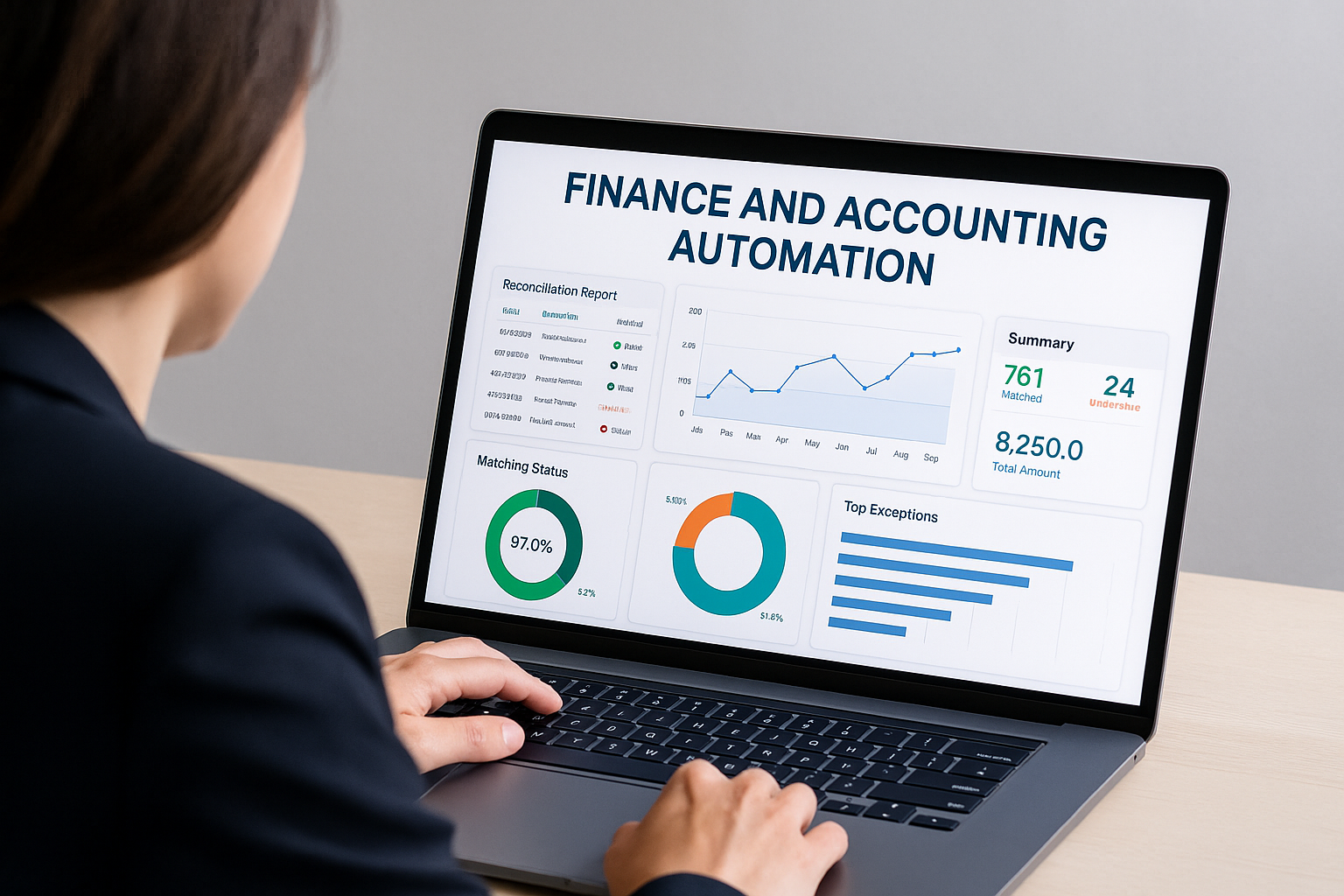
In today’s fast-moving business environment, the finance and accounting (F&A) function is under more pressure than ever. Whether it’s from tighter regulatory standards, faster close cycles, greater transaction volumes, or the need for high accuracy, manual reconciliation processes are increasingly becoming bottlenecks. In this blog we’ll explore how automation in finance and accounting, especially around reconciliation can ease key pain-points, the real-world scenarios where it matters, and how your PeopleOps / Finance Ops team can help drive this transformation.
What is Reconciliation in Finance & Why It Matters
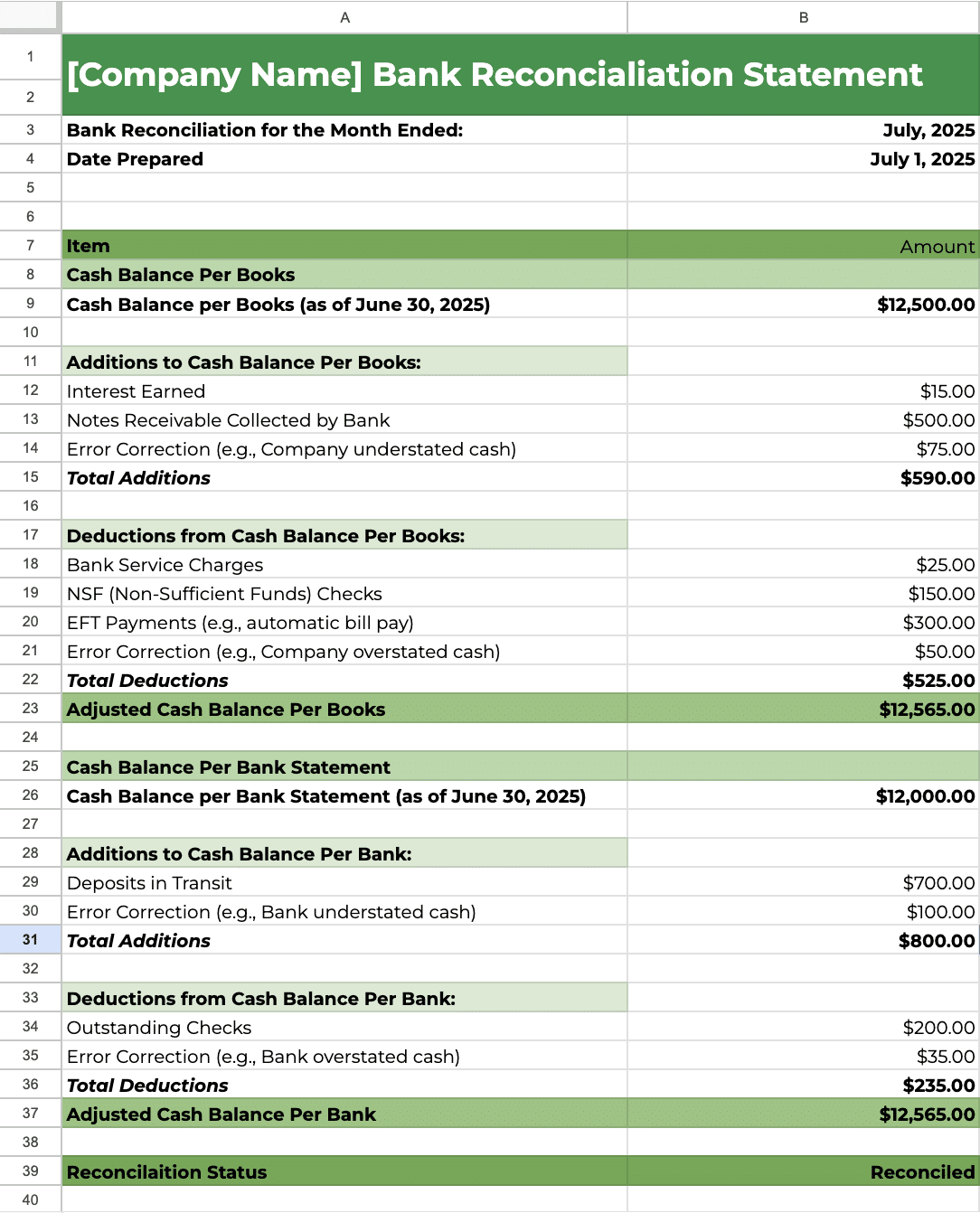
Reconciliation in accounting refers to the process of comparing two sets of records (for example bank statements vs company ledger) to ensure they agree, spot discrepancies, and correct them. Wikipedia+2Trintech+2
For finance teams, reconciliation is a foundational control. It helps ensure:
- Accurate financial records (no missing or duplicate transactions)
- Compliance with accounting standards and audit requirements
- Insight into cash flow, working capital, and operational health
When manual reconciliation is delayed, error-prone or done infrequently, the risks are tangible: late closes, misleading data, loss of trust, audit issues and increased cost.
What’s Wrong with Manual Reconciliation
Let’s unpack the typical pain-points that many organisations still face when they rely heavily on spreadsheets, manual matching, emails and ad-hoc processes:
1. Human error and data entry risk
Manual processes inherently carry a high risk of mistakes, typos, duplicate entries, omission of transactions, mis-matches, formula errors in spreadsheets. One provider notes that 95% of reconciliation errors come from manual mistakes. HighRadius+1
2. Time-consuming and resource-intensive
Matching thousands of transactions manually, tracing variances, escalating exceptions, it’s labour intensive and drains capacity. Organisations spend a large portion of their time just keeping the lights on. HighRadius+1
3. Poor scalability
As transaction volumes, bank accounts, inter-company entities or currencies increase, manual methods struggle to keep up. Growth becomes constrained by the capacity of people rather than systems. HighRadius+1
4. Lack of real-time insight
Manual reconciliations tend to be periodic (monthly/quarterly) and do not provide up-to-date visibility into cash flow or discrepancies. That means issues may go unnoticed for longer. HighRadius+1
5. Compliance and audit risk
With manual processes spread across spreadsheets and email threads, control and traceability suffer. Audit trails may be weak, increasing risk of mis‐statement or regulatory issue. Trintech+1
Real-world scenario
Consider a mid-sized manufacturing firm with 15 bank accounts, each daily supporting hundreds of transactions (payments, receipts, inter-company transfers). The month-end reconcile takes their finance team five days, with multiple exceptions left unresolved. The team is stuck hunting spreadsheets, reconciling mismatches, chasing other departments for missing info and as a result, senior leadership does not have final numbers until well into the new month. Cash flow visibility is poor, late payments create supplier friction, and mistakes are creeping in.
How Automation Changes the Game
Automating reconciliation and more broadly finance & accounting processes means leveraging technology (rules-engines, AI/ML, robotic process automation or RPA, integrations) to do much of the heavy lifting, allowing your team to spend less time on manual matching and more time on analysis, insights and exception resolution.
Here are key ways automation supports reconciliation:
- Automatic ingestion of data from multiple sources (bank feeds, ERP, payments platform) and matching transactions based on configurable rules. NetSuite+1
- Application of rules-based logic or AI to match ledger entries with bank transactions, flag unmatched items, and link to source documentation. HighRadius+1
- Real-time or continuous reconciliation: rather than waiting for month-end, processes can run daily or in near-real-time, improving visibility. NetSuite+1
- Stronger audit trails and control, with workflows routing exceptions, logging actions, and enabling compliance documentation. Trintech+1
- Scalability and cost efficiency: as volumes grow, automation systems scale easier than manual teams. Financial Cents
Scenario: From Manual to Automated
Returning to the manufacturing firm example above: by implementing an automated reconciliation tool, they now connect all bank feeds to their accounting system, apply matching rules (e.g., amount, date, reference), and transactions that match are auto-reconciled in minutes. Exceptions are flagged and routed to the finance analyst for review. Month-end close time shrinks from five days to one day; cash flow visibility is updated daily; the team is freed from mundane matching to focus on investigating trends, improving processes, and supporting business decisions.
Key Benefits of Automation in Reconciliation
Here are the tangible benefits you can expect when you move to automated reconciliation (and more broadly F&A automation):
- Improved accuracy & fewer errors — automated processes reduce human mistakes, mismatch rates drop. Financial Cents
- Faster reconciliation and close cycles — time to reconcile and close can shrink dramatically (some report 60-80% faster). Financial Cents+1
- Better scalability — whether you have more accounts, entities, currencies or channels, automation supports growth without proportional increase in manual effort. HighRadius
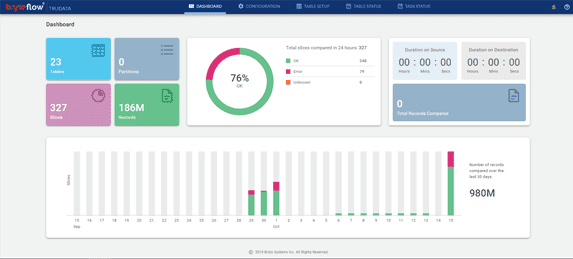
- Real-time visibility and better cash flow control — daily reconciliations and dashboards mean finance sees issues early, supports business decisions. Concur
- Enhanced compliance and audit readiness — standardised workflows, logs, clear trails mean reduced audit risk and stronger internal controls. Trintech
- Higher employee satisfaction and strategic work — fewer repetitive tasks means finance teams spend more time on analysis, insight, value-added work. nominal.so
Implementation: How PeopleOps / FinanceOps Should Approach It
Shifting from manual to automated reconciliation is not simply a software install, it’s a process change, people change, data change. Here’s a practical step-by-step view:
1. Assess current state
Map your current reconciliation processes: how many accounts, number of transactions, number of unmatched items, how many man-hours spent, what errors occur, what pain points exist. Identify the “manual heavy” areas.
2. Define the vision & objectives
What do you want to achieve through automation? Faster close, fewer errors, real-time visibility, cost savings? Set measurable targets (e.g., reduce manual match exceptions by 50%, reduce close from 5 days to 1, etc.).
3. Select the right technology & partner
Look for a solution that integrates well with your ERP/accounting system, has strong matching capabilities, configurable rules, scalability, real-time feeds, dashboards. The vendor should have experience in F&A automation. Concur+1
4. Configure & standardise processes
Automated work best when underlying processes are streamlined. Standardise your reconciliation templates, define rules (e.g., match by date/amount/invoice reference), define exception workflows, define roles/responsibilities. Trintech+1
5. Data and integration
Ensure data sources are clean, feeds are reliable, mapping of accounts is correct. Create seamless pipelines from bank statements, internal ledgers, payment gateways into the reconciliation tool.
6. Pilot and scale
Begin with one area (maybe bank reconciliation for one entity) to validate the set-up, refine rules, train users. Then scale across more accounts, entities, intercompany reconciliation, etc.
7. Training and change management
Educate your finance team on the new process, tools, their role shifts (from matching to exception review). Communicate benefits clearly (less manual work, more strategic tasks).
8. Monitor, refine and continuously improve
Once live, track metrics (time to reconcile, unmatched/exception volumes, error rates). Use dashboards. Refine rules and workflows over time. Introduce more automation like AI/ML for complex matching. HighRadius
9. Governance and controls
Set up monitoring of the automated system: ensure rules are working, manage exceptions timely, maintain audit trails. Modernisation doesn’t remove compliance risk, it changes the nature of it.
The Role of PeopleOps / FinanceOps in Driving Change
As a PeopleOps or FinanceOps leader, your role is pivotal:
- Advocate the business case for automation (time saved, cost reduction, strategic value).
- Collaborate across finance, IT, operations to ensure alignment of systems, data, process.
- Lead change management: communicate, train, support the finance team in the shift.
- Define metrics and track benefits, report to leadership.
- Ensure that talent within the finance team evolves, from manual tasks to strategic analytics, escalation of exceptions, coaching and oversight.
- Embed automation as part of broader operational excellence in finance: reconciliation is one component, but you can extend to accounts payable, inter-company, fixed assets, etc.
Considerations & Risks to Watch
While automation offers big benefits, implementation must be thoughtful. Some risks/considerations include:
- Rule configuration mistakes: If matching rules are too loose or too strict you’ll still generate large volumes of exceptions.
- Data quality issues: Garbage in, garbage out. If bank feeds or ledgers are messy, automation will struggle.
- Systems integration: Poor integration between bank/ERP/payment systems leads to gaps, manual workarounds.
- Change resistance: Finance teams used to spreadsheets may resist new workflows. Training and leadership support is key.
- Over-reliance on automation: Automation doesn’t replace judgement. Some exceptions still require human review.
- Audit & control oversight: Automated doesn’t mean invisible. The system needs proper controls, documentation, governance.
- Scalability & future-proofing: Choose tools that can handle growth (e.g., more banks, more currencies, more entities, more complex transactions).
Summing Up: Why It Matters for Your Business
In short: If your finance team is still spending large portions of time on manual reconciliation, you’re leaving value on the table. By automating reconciliation and related F&A tasks:
- You free up the team to focus on strategy, analysis and business partnering.
- You reduce errors, improve data accuracy, reduce audit/compliance risk.
- You accelerate month-end close and improve financial visibility.
- You enable scalability as your business grows.
As a PeopleOps/FinanceOps partner to the business, you have an opportunity: to turn finance from a cost-centre focused on transaction matching into a partner delivering insight, agility and control.
Call to Action: How PeopleOps Can Help Now
If you’re reading this and you manage or support finance operations, here’s what you can do today:
- Hold a workshop with your finance team: map how much time is spent on manual reconciliation, how many unmatched items, what pain-points exist.
- Identify quick-win areas: maybe one bank feed, one entity, where automation could immediately reduce time/effort.
- Build the business case: quantify time/cost savings, error reduction, benefit to business decision-making.
- Select your partner: evaluate reconciliation automation vendors based on integration, matching capabilities, scalability, user experience.
- Communicate: talk to your team about how this will change their work not eliminate their role, but move it from repetitive tasks to higher-value activity.
- Track metrics: set baseline metrics (time to reconcile, number of exceptions, cost per reconciliation) and track improvements.
Closing Thoughts
Automation in finance and accounting is no longer a “nice to have”, it’s becoming essential for organisations that want to stay competitive, efficient and accurate. Reconciliation may sound like a low-profile process, but it’s foundational. By cutting down on manual reconciliation you’re not just saving time you’re improving financial health, enabling real-time insight and empowering your team for higher-value work.
If you’d like help mapping your reconciliation process, building the automation roadmap or evaluating tools, the PeopleOps/FinanceOps team is here to partner. Let’s turn reconciliation from a bottleneck into a strategic advantage.
Leave a Reply