
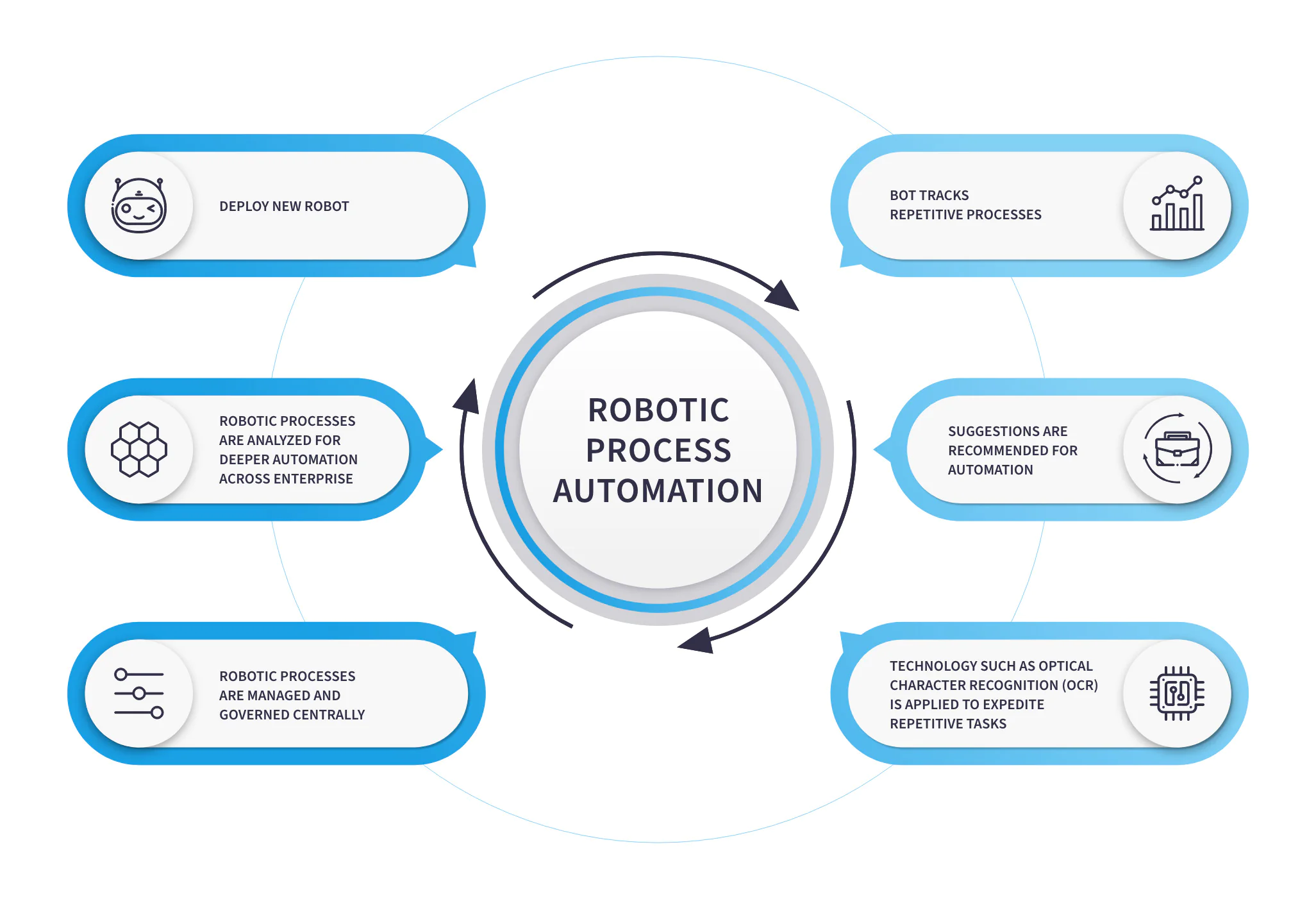

In today’s fast-moving digital world, companies increasingly deploy automation, whether via robotic process automation (RPA), workflow bots, AI-enabled tools or process-orchestration platforms. But many PeopleOps, HR and business leaders still treat automation as a one-off project: pick a process, automate it, show some savings, then move on. That approach can deliver value, but often lacks the architecture to generate recurring revenue, sustained efficiency, and cumulative momentum.
In this article we introduce the concept of the Automation Flywheel, explain key pain-points, show how a PeopleOps team can deploy it, and demonstrate how it allows organisations to move from one-time wins to a sustainable, growing automation programme that drives recurring benefit (and revenue).
1. The Pain: Why One-Off Automations Fall Short
1.1 Single-process mindset
Often organisations pick a high-volume, manual process (for example: expense claim approvals, onboarding paperwork, data entry) and automate it. This gives a great return, but:
- It may not scale beyond that initial process.
- The automation often sits in isolation, not connected into wider workflows.
- Once the win is achieved, there’s no “what next?” roadmap.
1.2 Siloed delivery and lack of governance
Frequently, automation is handled by a specialist team or vendor, but there is no broader “centre of excellence”, governance model or citizen-developer community. This leads to:
- Bottlenecks in creating new automations.
- Low awareness among business users of how automation can help them.
- Risk of duplication, unmanaged automations, or shadow IT.
1.3 Missed opportunity for recurring value
Because many automation projects are discrete, they yield one-time cost-savings. But the business doesn’t reap:
- Recurring revenue uplift (in services or internal productivity).
- Continuous improvement and reuse across functions.
- Employee engagement by enabling end-users to contribute to automation ideas.
In short: the one-off approach lacks the mindset of building momentum and transferring automation from “nice to have” into “core business capability”.
2. The Flywheel Metaphor and Why It Works
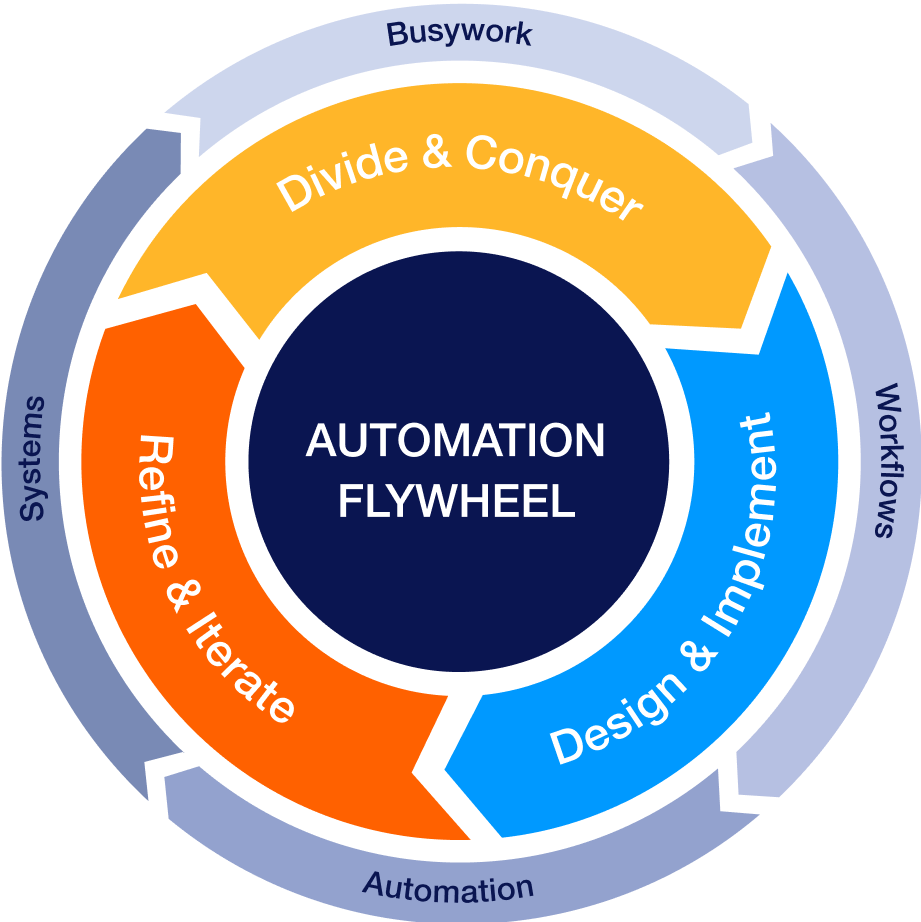
The term “flywheel” comes from mechanical engineering: a heavy wheel that once spinning stores momentum and continues to rotate with less input. In business, the metaphor is used for models where growth builds upon itself (rather than reset after each transaction). HubSpot+1
In the context of automation, the concept is:
- You build initial automations (force applied) →
- You reduce friction (processes become smoother) →
- Users adopt, generate new ideas →
- New automations get built, spinning the wheel faster →
- Compounding effect: more value, faster speed, greater scale.
A few important features:
- Momentum: each successful automation adds energy.
- Friction reduction: the smoother your architecture/governance/skills, the faster the flywheel spins.
- Self-sustaining: eventually the mechanism invites internal contributions (citizen developers) and becomes embedded.
For example, one piece cites that after initial automations, employees began submitting ideas, and a large insurance firm went from 5 automations to a backlog of 100+ ideas. UiPath+1
3. Applying the Automation Flywheel in PeopleOps
Here’s how a PeopleOps function can adopt and operationalise the flywheel for process automation, moving from patchwork to programme.
Step A: Establish your Automation Centre of Excellence (CoE)
- Set up a dedicated team (or cross-functional steering group) that will govern automation initiatives: prioritisation, standards, metrics, infrastructure.
- Identify and prioritise high-impact, low-variance processes (e.g., candidate screening, onboarding steps, compliance checklists) as first automations.
- Ensure tools, governance, data security/privacy, change management protocols are in place.
Step B: Deliver the first wave of automations
- Build and deploy automated workflows in targeted pilot areas. Show value: time saved, error reduction, improved user satisfaction.
- Communicate wins across PeopleOps and broader business.
- Train business users on how the new workflows work, and build trust.
Step C: Engage business users and unlock idea generation
- Once users see the benefit of automation, invite them to submit ideas for further automation. This broadens the “idea funnel” beyond the CoE.
- Offer training or tools (for example low-code/no-code platforms) for “citizen developers” to build smaller automations themselves under governance. accelirate.com+1
- Encourage a mindset shift: people think “What part of my job could be automated?”, rather than “Is automation even possible?”.
Step D: Scale, govern, embed
- Governance must scale too: ensure standards, documentation, version control, monitoring.
- Automations should become part of standard operations (not one-off projects).
- Measure not just savings per process, but automation velocity (how many automations built per quarter), reuse, ideation rate, employee satisfaction, time-to-value.
- Connect data and analytics so you can continuously discover new automation opportunities (process mining, task mining).
Step E: Transform into recurring-value model
- In PeopleOps you can link automation to recurring revenue or cost avoidance in various ways:
- Automate candidate-to-hire workflows so hiring cycles shorten, leading to faster productivity gains.
- Automate compliance/training so risk is reduced, cost of audits decreases annually.
- Automate HR service-desk queries (time off, payroll queries) so internal customers (employees) are more satisfied, retention improves (which drives cost savings).
- Build the automation programme into your business case year-on-year: each new cycle adds incremental benefit; you move from “we saved ₹X in this project” to “our automation engine generates ₹Y every fiscal year”.
- With strong references and repeatable patterns, you move from “one-off” to “repeatable service offering” internally or even externally (if your organisation offers shared services).
4. Real-World Scenario: HR Service Desk Automation
Let’s illustrate with a scenario.
Company: Global technology firm with a 10,000-employee workforce.
Pain-point: HR service-desk is overwhelmed with repetitive queries: “What’s my leave balance?”, “How do I update my address?”, “When is open-enrolment for benefits?”. Many queries are answered manually by HR reps.
Initial action (Step A/B): The CoE identifies this as a candidate for automation. They build a chatbot + workflow automation that answers common queries, updates HRIS automatically, and escalates only complex cases.
Outcome: HR reps are freed from 30% of ticket load; average response time drops from 4 hours to 30 minutes; employee satisfaction improves.
Engagement (Step C): HR business partners and employees observe the improved experience and begin asking: “What about onboarding tasks?”, “What about exit-clearance workflows?”, “What about payroll query automation?”
Scaling (Step D): The CoE builds further automations: onboarding document collection, exit clearance workflow, benefits enrolment reminder. The company measures automation velocity and reuse of components across departments. Governance ensures consistent logging, auditing, and security.
Recurring-value model (Step E): Because the HR service-desk volume is reduced and employee satisfaction improves, the firm estimates annual cost avoidance of ₹2 crore. Furthermore, improved onboarding speeds up new-hire productivity, leading to revenue impact. The automation effort becomes part of the PeopleOps annual budget and the firm projects growing benefit year-on-year.
Flywheel effect: With each automation people see the value, request new automations, contributing ideas. The CoE builds them, detail gets shared, reuse increases, the speed of delivering automation grows, the flywheel spins faster.
5. Common Pitfalls & How PeopleOps Can Avoid Them
Pitfall 1: Thinking automation = tools only
Too many organisations focus on acquiring an RPA/licensing tool and expect magic. But without process redesign, change management, governance and user-engagement, you’ll struggle to build momentum.
Fix: Combine technology with process review, stakeholder engagement, clear ROI definition, and governance framework.
Pitfall 2: Lack of user engagement / culture
If users don’t trust the automation (fear of job loss, unclear benefits), the flywheel stalls.
Fix: Communicate openly: automation augmenting work, not replacing people; highlight wins, involve users in ideation. Build a citizen-developer program.
Pitfall 3: No reuse or standardisation
If every automation is built from scratch with no shared components, the CoE becomes a bottleneck and the cost per automation remains high.
Fix: Build libraries of reusable components, standard templates, share across functions. Track metrics: automation build time, reuse rate.
Pitfall 4: Weak governance or uncontrolled growth
Letting users build automations freely without oversight leads to shadow bots, security, maintenance and compliance issues.
Fix: Define governance: review process, security standards, version control, auditing, change-management. The CoE remains the guiding body.
Pitfall 5: Measuring just cost-savings, not momentum
If you only measure “project saved ₹X”, you miss the bigger value of flywheel momentum (velocity of automations, idea pipeline growth, reuse, employee engagement).
Fix: Define metrics beyond cost-savings: number of automations built per quarter, idea submission rate, reuse percentage, employee satisfaction change, time to value.
6. Why PeopleOps Teams Are Ideally Placed to Drive the Automation Flywheel
PeopleOps sits at the intersection of business operations, HR service-delivery, employee experience, and process governance. This gives distinct advantages:
- You engage with the full employee lifecycle (hire to retire), so you see many manual repetitive tasks that are prime automation candidates.
- You can build strong business-case narratives: faster onboarding, higher employee satisfaction, lower attrition, improved productivity, all tied to the workforce which is inherently valuable.
- You often control or influence service-delivery metrics (time to resolve HR queries, employee feedback, cost per hire) which lend themselves to automation impact measurement.
- You can spearhead citizen-developer programmes focused on “My HR task gets easier if I automate it” and thereby accelerate the flywheel.
7. The Pay-Off: From One-Off Wins to Recurring Revenue & Strategic Value
By shifting from discrete automation projects to a flywheel mindset, organisations unlock:
- Recurring value: each new automation adds to the base of value and improves year-on-year benefit.
- Efficiency: faster delivery of new automations, reuse of assets, lower cost per automation.
- Scalability: internal capability (citizen developers + CoE) can scale beyond a few processes.
- Strategic positioning: automation becomes part of your operating model and employee experience, not just a cost-cutting tool.
- Employee engagement & innovation: business users contribute ideas, feel empowered, and the culture becomes automation-friendly.
- Better ROI for PeopleOps: instead of measuring isolated wins, you can show sustained business impact, fewer manual tasks, faster responses, better employee experience, lower turnover and improved productivity.
8. Getting Started: A Practical Checklist for PeopleOps
Here’s a quick checklist to launch your automation flywheel:
| Step | Activity |
|---|---|
| 1. Audit & Identify | Map existing PeopleOps/HR processes, identify high-volume, high-manual, low-variance tasks. |
| 2. Set up CoE | Define team, roles, governance model; select automation platform; define metrics. |
| 3. Deliver Pilot | Build your first 1-2 automations, show value, communicate success. |
| 4. Engage Users | Run awareness sessions, invite idea submissions, consider citizen-developer training. |
| 5. Reuse & Scale | Create templates or libraries, share across functions, track reuse. |
| 6. Governance & Reporting | Define standards, monitor compliance/security, report not just savings but velocity, reuse and engagement. |
| 7. Embed Recurring Model | Frame automation as part of annual plan; align with PeopleOps KPIs like time to hire, HR cost per employee, employee satisfaction. |
| 8. Continuous Discovery | Use process mining, task mining or listening to employees to surface next automation opportunities; iterate. |
9. Conclusion
The journey from one-off automation projects to a thriving automation programme is exactly what the “automation flywheel” framework captures. For PeopleOps professionals, adopting this mindset means not just executing isolated robotics or bots but building a self-sustaining engine of process improvement, user engagement, reuse and sustained business impact.
When you spin your flywheel properly: you deliver improved employee experience, faster HR/PeopleOps service-delivery, recurring cost avoidance, and measurable strategic value for the organisation.
If you’d like help structuring your PeopleOps automation programme, setting up the governance model, selecting the right processes or measuring the flywheel’s momentum — we’re here to help you turn that first spin into a full-blown engine of value.
Leave a Reply