

Introduction
In today’s fast-moving business and technology landscape, organizations are under pressure to deliver more with less, less time, fewer resources, and greater efficiency. For PeopleOps teams (also known as Customer Success, Client Success, or Customer Experience functions), this means our focus isn’t only on keeping customers happy, but on helping them achieve time saved, operational efficiency, and business results.
In this article we’ll explore:
- what we mean by customer success stories that emphasise time saved and results gained,
- common pain points and problems customers face that PeopleOps can help address,
- real-world scenarios illustrating how savings in time translate into meaningful outcomes,
- how PeopleOps teams can craft and present these stories to highlight value.
Let’s get started.
What is a Customer Success Story (and why time & results matter)
A customer success story (often called a case study) is a narrative documenting how a customer overcame a challenge with your help, and what benefit they gained. Isoline Communications+2Influitive+2
But what makes a story particularly powerful today is the inclusion of measurable outcomes, for example time reduction, cost savings, productivity gains, efficiency improvements. According to The Simons Group: “what results do buyers care about? … time savings” is explicitly listed. The Simons Group
In short: it’s not enough to say we helped a customer get better. You want to say we helped them save X hours, reduce manual work by Y %, or increase productivity by Z %. That’s what resonates, especially with both technical and business readers.
For PeopleOps teams, these stories serve multiple purposes:
- Demonstrate proof of value to both internal stakeholders (e.g., leadership, sales, product) and external customers.
- Build trust and credibility as one article says: “people naturally trust what their peers say more than any marketing message you could craft.” Social Media Examiner+1
- Support retention, upsell, and advocacy efforts by turning customers into champions.
Common Pain Points: What leads to “time lost” and “inefficiency”
Here are common challenges that customers face and that PeopleOps teams are well placed to help solve:
- Manual, repetitive processes
- Data entry, spreadsheets, manual coordination across teams.
- These take time, are error-prone, and scale poorly.
- Example: A finance team manually reconciles reports, thereby delaying month-end close.
- Poor tool adoption or fragmented tooling
- Multiple tools with overlapping functionality, or tools not used effectively, create inefficiencies.
- For example: A company buys a CRM, but only some departments really adopt it others keep working outside, so data is inconsistent.
- Implementation or onboarding bottlenecks
- When onboarding new customers, the time taken from purchase to value-realised is too long.
- A delayed implementation means delayed results and higher risk of churn.
- Limited visibility into usage, outcomes or health
- Without dashboards or metrics, companies cannot track whether their investment is delivering value.
- If you can’t measure “time saved” or “tasks automated”, you can’t optimise it.
- Resource constraints / growing expectations
- Especially in scaling businesses: “do more with the same headcount”.
- Time is the most precious resource: saving hours = freeing people to focus on higher-value work.
When PeopleOps intervene and address these pain-points, the theme becomes: we helped the customer recover X hours per week/month, automate Y % of their work, reduce error by Z %, which translates into business value: cost savings, faster time-to-value, happier users, better retention.
Real-World Scenario: Time Saved → Results Gained
Let’s imagine two illustrative scenarios that blend technical and business perspectives, and show how PeopleOps can shape the narrative.
Scenario A: Automated Onboarding in a SaaS Company
Problem: A B2B SaaS customer (let’s call them “AcmeCorp”) was onboarding new users manually: each new user required a team member to manually send welcome emails, set up permissions, run training sessions, monitor usage, follow-up. The process took ~4 weeks from signup to “active user”. The operations team spent ~10 hours/week on onboarding tasks.
Solution from PeopleOps:
- Introduced an onboarding workflow automation: trigger email sequences, role-based permissions set-up, training calendar integration.
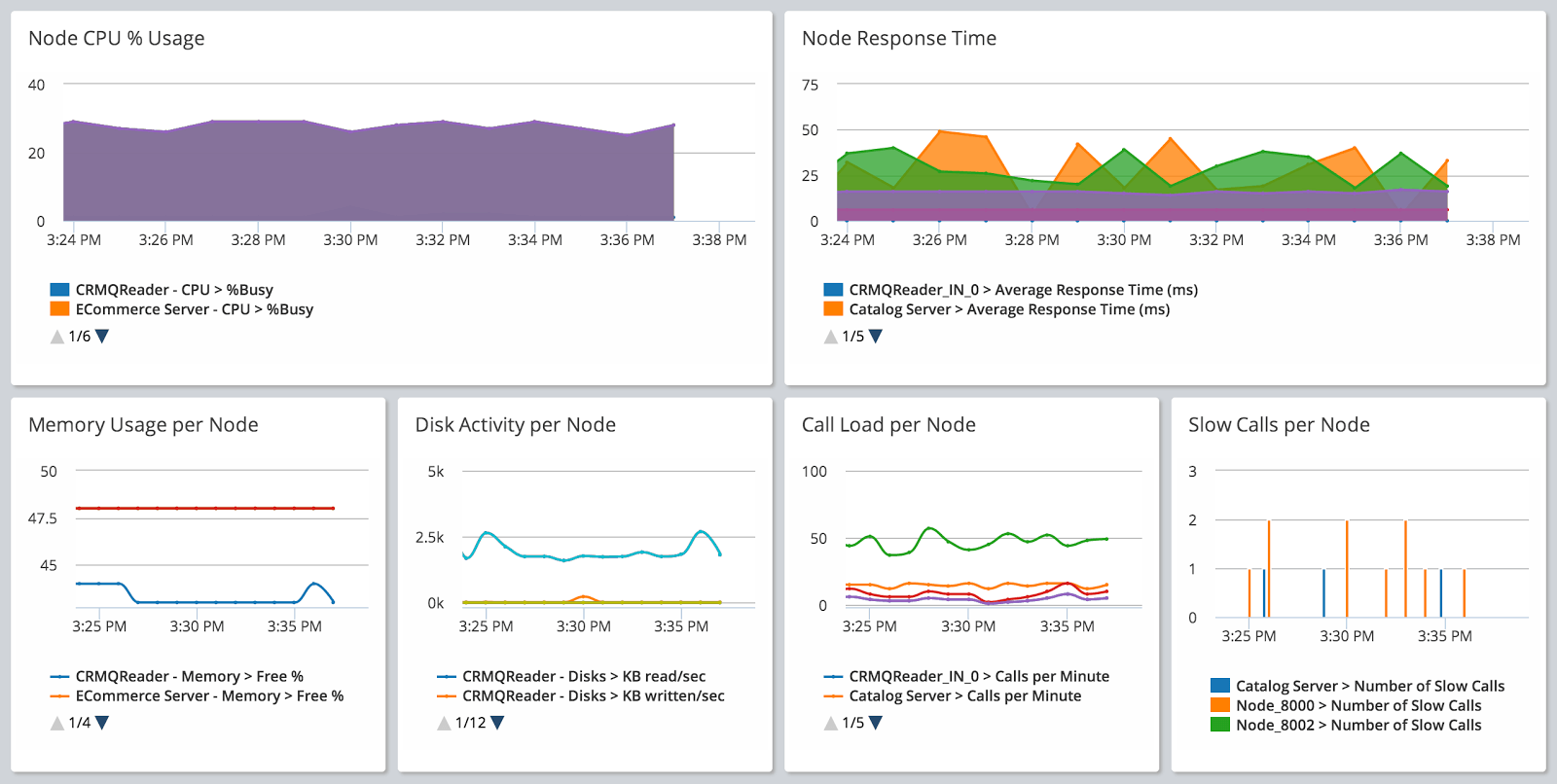
- Built a dashboard to show onboarding progress, time spent, drop-off points.
- Instituted recurring check-ins with the customer to optimize “time to value”.
Results:
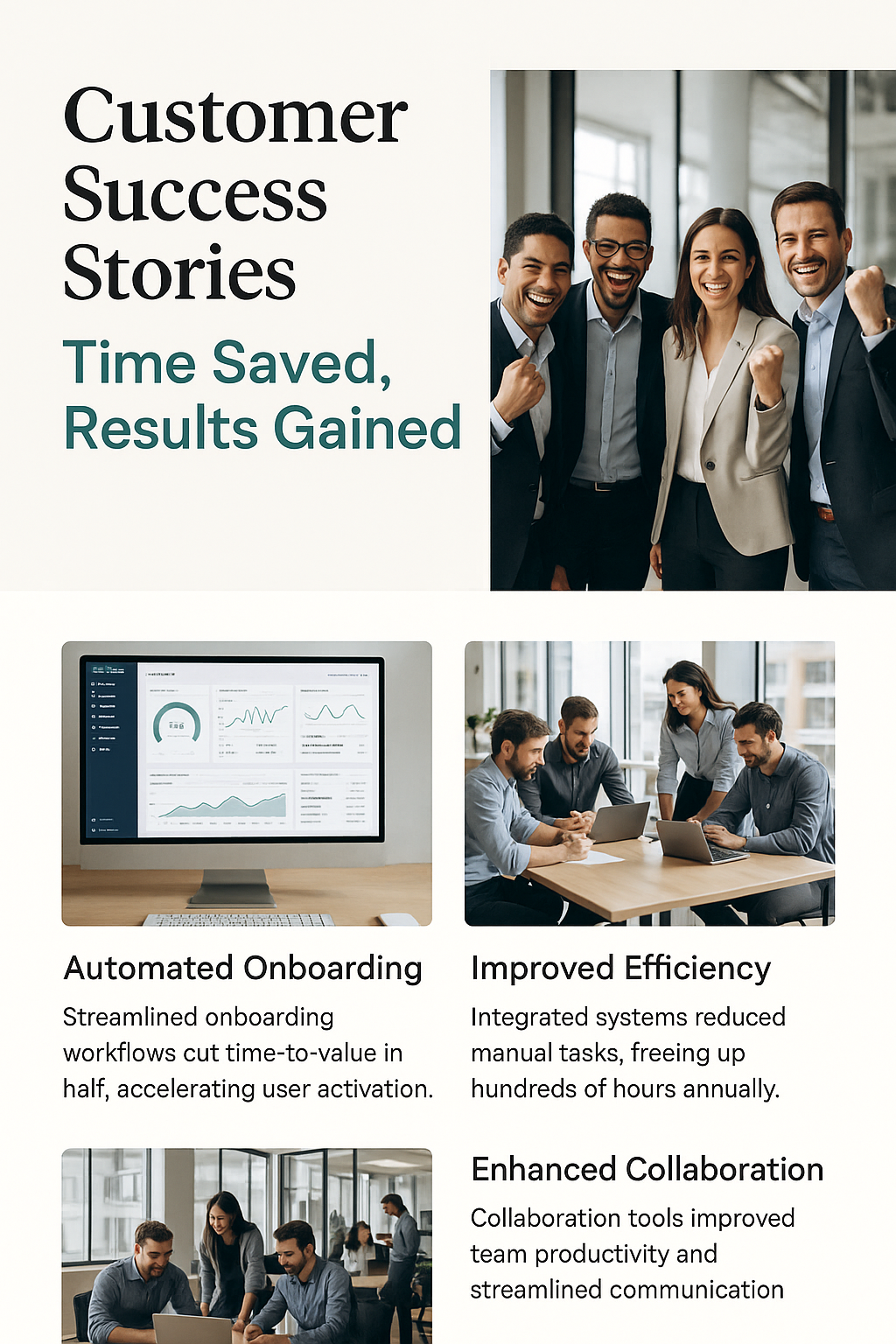
- Onboarding time reduced from 4 weeks → 2 weeks (50 % faster).
- Operations team time reduced from ~10 hrs/week → ~3 hrs/week (7 hrs saved per week = ~364 hrs/year).
- New users reached “active” status (say usage > X) 30 % faster.
- Business impact: faster revenue realisation, improved customer satisfaction, operational cost savings.
Framing the story:
- Time saved: 364 hrs/year of internal operations time.
- Results gained: onboarding pipeline speed increased, revenue realised sooner, fewer drop-offs, higher NPS from new users.
- Quote from customer: “With the new automated workflow we can spin up new users in half the time, freeing our team to focus on value-add tasks instead of manual setup.”
Scenario B: Data Integration for a Manufacturing Firm
Problem: A mid-sized manufacturing firm (“BuildIt Inc.”) had separate systems: ERP, production floor system, quality management system. Data silos meant their quality team spent ~15 hrs/week reconciling production data and reporting. Decision-making was delayed.
Solution from PeopleOps + Partner-IT team:
- Facilitated integration of systems (via APIs, data pipelines) so production and quality data flow into a unified dashboard.
- Created “trigger alerts” for quality deviations and real-time reporting for leadership.
- Rolled out training to ensure adoption of new workflows.
Results:
- Quality team time reduced from ~15 hrs/week → ~5 hrs/week (10 hrs saved/week = ~520 hrs/year).
- Decision-making improved: issues identified in hours instead of days → downtime reduced by say 12 %.
- Business impact: faster reaction to quality issues, fewer defective units, improved output and customer satisfaction.
Framing the story:
- Time saved: ~520 hrs/year of manual reconciliation.
- Results gained: Downtime cut by 12 %, quality improved, operational costs reduced.
- Quote from customer: “We used to spend half a day every Monday untangling last week’s production data. Now it’s done in an hour and we act immediately on insights.”
These scenarios show how PeopleOps work, across systems, people, processes can drive both operational time savings and business outcomes. When we craft stories like this, the audience (technical and business) sees both sides: the mechanics of what changed and the business result that matters.
How PeopleOps Can Frame and Publish These Stories
Here are best-practice tips for PeopleOps teams who want to turn success stories into powerful content for their WordPress blog (or other channels):
1. Select the Right Stories
Choose customers who:
- Have achieved measurable outcomes (time saved, cost reduced, throughput increased). The Simons Group
- Are willing to share data and quotes.
- Represent target segments you want to influence.
- Have a compelling narrative (challenge → solution → results).
2. Use the Problem → Solution → Result Structure
- Problem: What was the pain/inefficiency?
- Solution: What did PeopleOps do (tools, process, training, enablement)?
- Results: Time saved, business impact, metrics.
Experts recommend this simple structure for clarity. Wilton Blake+1
3. Highlight Time Saved as a Metric
Don’t bury it in prose, call it out. Example: “Saved 10 hrs/week = 520 hrs/year”. Time saved is a universal metric that resonates with both tech and business audiences (who understand hours = cost, lost opportunity, productivity).
4. Use Real Data + Customer Voice
- Quantitative: Numbers matter. Percentages, hours, improved metrics. Foundation Marketing+1
- Qualitative: Quotes from the customer add trust and make it relatable. For example: “We used to spend 15 hrs every Monday reconciling production data now it’s done in an hour.”
5. Use Visuals
- Graphs or charts showing “before vs after” time metrics.
- Screenshots of dashboards or workflows (with customer permission).
- Customer photos (if permitted), or team shots to put a human face on the story.
As one article emphasises: “visuals make the case study more visually appealing and engaging … using charts or graphs to show progress”. Foundation Marketing
6. Make the CTA & Internal Distribution Smart
- End with a meaningful CTA: “Want to cut onboarding time in half? Let’s talk.”
- Internally share these with your team: they boost morale and help your organisation see the value added. Isoline Communications
- Repurpose for different channels: blog post, social media snippet, one-pager, customer webinar. Social Media Examiner
How PeopleOps Professionals Deliver This Value
From a PeopleOps perspective, how do we set the stage for these stories? What practices enable these time-savings and results?
- Onboarding Excellence: Clear workflows, automation, checklists, training.
- Tool Adoption & Enablement: Ensuring customers get value faster from your product/service.
- Process Optimisation: Reviewing bottlenecks, hand-offs, and manual tasks.
- Metrics & Dashboards: Defining KPIs such as time-to-value, user adoption, hours saved.
- Cross-functional Collaboration: Working with Sales, Product, Support to remove friction.
- Customer Voice & Feedback Loops: Regular check-ins, listening to what slows them down, and being proactive.
When PeopleOps operates with that mindset, the stories naturally follow because the results are real and measurable.
Conclusion
For PeopleOps teams, customer success stories are not just marketing collateral, they are proof points of the value your team brings. And when you emphasise time saved and results gained, you speak both to the heart of the business decision-maker and the analytical mind of the technical stakeholder.
By choosing the right stories, structuring them properly, using real data and visuals, and framing time savings as a central metric, you amplify your impact. Moreover, these stories reinforce internal alignment, help with retention, upsell, advocacy, and ultimately position your organization as a partner in your customer’s success.
Leave a Reply