
Introduction
In today’s dynamic enterprise environment, organisations are increasingly adopting finance automation solutions. Whether it’s automating accounts payable, closing the books, reconciling ledgers or generating financial insights, the demand for scalable, value-driven finance tech is rising. At the same time, customers expect pricing models that align with their usage and tangible business outcomes, not just a flat license fee.
For companies in the PeopleOps / FinanceOps / FinTech space, designing a robust pricing model that resonates with both technical buyers (finance, FP&A, RevOps) and business stakeholders (CFO, CEO, board) is critical. This blog explores a three-component pricing playbook—Base + Usage + Value Share, tailored for finance automation solutions.
We’ll walk through:
- what each component means;
- the pain points it addresses;
- why this hybrid model makes sense;
- how to implement it in practice;
- and how PeopleOps (your team) can help guide organisations through this transition.
Why we need a new pricing model for finance automation
Finance automation is no longer just replacing manual tasks; it’s driving value: faster closes, fewer errors, real-time insights, cost savings, enabling strategic decision-making. A rigid seat-based or flat subscription model often fails to capture that value. Some of the pain points:
- Misalignment of value and cost: If you charge purely by seat or fixed licence, you might under-capture value when automation drives large downstream savings, or conversely, over-charge small users.
- Scalability and adoption hurdles: Finance automation often scales with usage (e.g., number of invoices processed, number of reconciliations, number of users/teams enabled) so a purely fixed model lacks flexibility.
- Customer trust and fairness: Customers want pricing that reflects what they use and the business value they derive, this builds stronger relationships and reduces friction.
- Operational complexity for vendor: Implementing usage or value-based models requires new infrastructure (metering, value quantification, billing logic) and finance teams must be comfortable forecasting variable revenue streams. As research shows, usage-based pricing demands cross-functional coordination across product, finance, GTM. Chargebee+1
- Competitive differentiation: In a crowded SaaS/finance-automation market, offering flexible, outcome-aligned pricing can be a differentiator.
With these realities, the hybrid model of Base + Usage + Value Share becomes attractive: it combines predictability, fairness, scalability and alignment to customer outcomes.
What is Base + Usage + Value Share?
Here’s a breakdown of the three components:
1. Base
This is a fixed recurring fee, monthly or annual, that covers core access, onboarding, support, minimal usage entitlement. It ensures vendor has a predictable minimum revenue, covers fixed costs, and delivers a baseline of service.
Why this matters
- It provides stability for both vendor and customer.
- Enables upfront cost recovery (onboarding, implementation) without making everything variable.
- Makes budgeting easier for customers (they know their minimum spend).
- Establishes the relationship and value proposition before variable kicks in.
2. Usage
This component charges based on measurable consumption metrics: number of transactions processed (invoices, payments, reconciliations), number of automated workflows executed, volume of data processed, number of enabled departments/users. The metric should closely map to value delivered: the more you use automation, the more benefit.
Industry context
Usage-based pricing is increasingly common in SaaS and automation. According to one guide, usage-based (or consumption-based) pricing “enables customers to pay for a product according to how much they use it” and is becoming widespread. OpenView+1
Another playbook outlines how to choose the right value metric, ingest usage events, build billing engines and migrate customers. Chargebee
How usage applies in finance automation
Example metrics: number of invoices processed through the system, number of finance closes, number of reconciliation matches auto-resolved, number of users with access, volume of data ingested, time saved.
If you process 10,000 invoices, you pay more than if you process 1,000, but you also derive more value.
3. Value Share (Outcome-based)
This is the advanced component: you tie a portion of your pricing to the realised business value or savings your customer gains (for example, percentage of cost savings, % of error reduction, % of time saved, or share of incremental revenue unlocked). It aligns vendor incentives with customer success.
Why include value share
- Signals strong alignment: you only succeed when your customer succeeds.
- Enables wins for both sides and opens discussions about ROI and business impact.
- Improves customer retention and advocacy because value is clear and measurable.
Real-world scenario
Suppose your finance automation solution helps a mid-size enterprise reduce invoice processing cost by $200,000/yr. You could structure a value share: say 10% of proven cost savings = $20,000 additional fee. The customer pays the base + usage + this value share if and only if the savings materialise.
Why this hybrid model works for finance automation
Let’s map back to the pain points and show how Base+Usage+Value Share addresses them.
- Predictability + scalability: The Base provides stability; the Usage element allows growth; the Value Share ensures reward for success. Customers know their minimum investment and can scale; vendors get upside.
- Fairness and alignment: Usage links directly to consumption; Value Share links directly to outcomes. Customers feel they pay for what they get; vendors capture incremental upside when they deliver value.
- Adoption driver: With usage-based component and outcome sharing, customers can adopt incrementally and see value before large commitments. This lowers barrier to entry and accelerates adoption.
- Competitive differentiation: Many solutions still charge flat licence fees. Offering this model signals modern pricing sophistication and customer-centricity.
- Internal leverage for vendor teams: Sales teams can talk ROI and business impact, not just features. Customer Success teams focus on value realisation (which triggers the value share). Finance and RevOps can quantify usage and outcomes.
- Evolving with the product: As your finance automation capabilities expand (AI/ML, predictive finance, shared services), usage metrics may change and value share can grow with deeper impact.
Practical Implementation Steps
Here is a step-by-step playbook for how your PeopleOps team can help a vendor implement Base + Usage + Value Share pricing for a finance automation product.
Step 1: Define the value proposition and key metrics
- Map the workflows: e.g., invoice processing, approvals automation, month-end close, reconciliation, reporting.
- Quantify the business impact: cost savings (labour hours freed × cost/hour), error reduction, cycle time reduction, improved cash flow, working capital gains.
- Select usage metrics tied to consumption and value: e.g., number of invoices processed, number of workflows executed, number of users/teams onboarded, volume of finance transactions.
- Define the value share trigger: e.g., “we share 10% of verified cost savings above baseline”.
Step 2: Set the base fee
- The base should cover fixed costs: onboarding, support, access, initial integration.
- It needs to be appealing and low enough to allow adoption but high enough to justify the service and implementation.
- Optionally tier base levels (e.g., Standard, Premium) depending on access or support levels.
Step 3: Build the usage tier & overage logic
- Decide a usage metric. E.g., up to X invoices/month included in base; beyond that, usage fees apply.
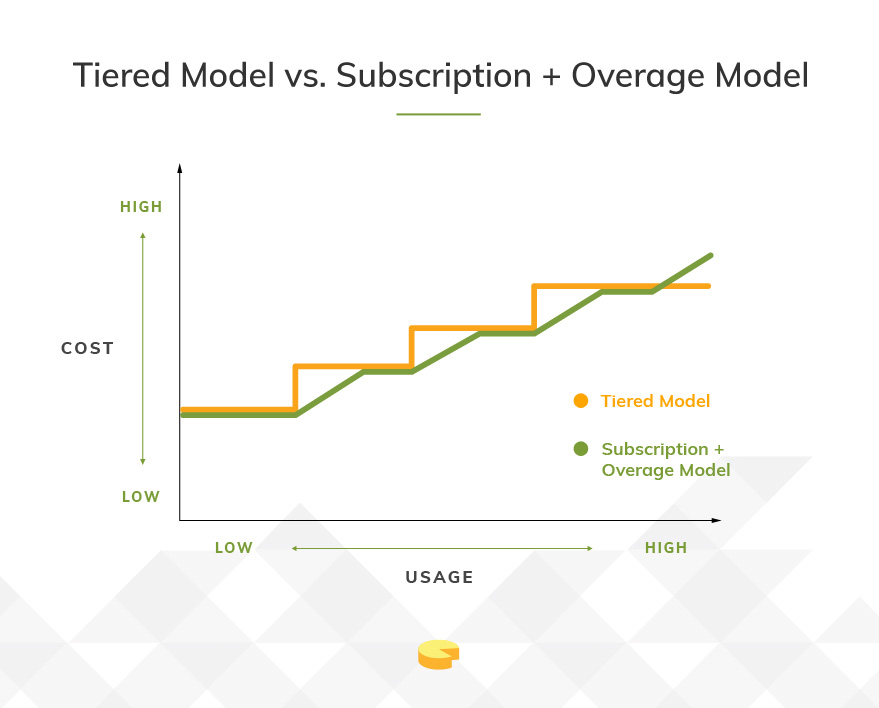
- Choose tiered pricing or linear pricing (e.g., first 10k invoices at $Y, next at $Z).
- Ensure your product can meter usage cleanly and transparently: capturing usage events, reporting, dashboards. This is critical to trust. Lago+1
- Determine how to handle growth: volume discounts, overage caps, alerts to avoid “bill shock” (a known issue in usage models). Salesforce
Step 4: Define the value share mechanism
- Determine baseline: what is the customer’s “before automation” cost or cycle? For example, processing invoices manually took 15 minutes/invoice at cost X.
- Define measurement methodology: how will you verify savings? Do you need audit reports, customer data, external benchmarking?
- Set the % share: typical value-share models might use 10-30% of proven savings (depending on risk, value magnitude).
- Decide duration: for how many months/years will value share apply? Usually until ROI is achieved or for the term of contract.
- Consider minimum guarantees/floors so vendor isn’t exposed to risk completely.
Step 5: Communicate the pricing clearly
- Prepare pricing sheets that show Base + Usage + Value Share in one view.
- Provide worked examples (e.g., small/medium/large customer scenarios).
- Highlight the value proposition: “You pay more as you use more and as we deliver more value”.
- Ensure transparency: dashboards, usage reports, savings verification documentation.
Step 6: Align internal teams
- Sales: Need to sell not just features but ROI and value share component. Compensation might need to align (e.g., sales reps might get bonus based on usage growth and value realisation, not just contract value). OpenView
- Customer Success: Their primary job becomes driving adoption and value realisation so that usage goes up and value share gets triggered.
- Finance/RevOps: Must update forecasting models to handle variable revenue (usage + value share), manage billing/invoicing, integrate metering and auditing.
- Product: Need telemetry for usage and value; instrument workflows; ensure analytics is present to track value metrics.
Step 7: Monitor, iterate, optimise
- Track key metrics: customer lifetime value (CLTV), net revenue retention (NRR), usage growth, value share payouts, customer satisfaction.
- Use feedback loops: Are customers seeing value? Are they comfortable with usage and value share model? Adjust tiers, share % as needed.
- Experiment with segments: Maybe for enterprise customers you increase value share % (higher risk/higher reward); for smaller customers maybe usage includes more in base, lower value share.
- Migrate over time: If you have legacy customers on flat pricing, you may phase in new model gradually (for new customers first, then retrofit with grandfathering). This is a recommended approach for pricing transitions. Forbes
Use Case: A Real-World Scenario
Here’s a simplified illustrative scenario to bring it to life:
Company: Mid-sized manufacturing enterprise with large finance operations (~50,000 invoices/year).
Solution: Finance automation platform offers invoice processing, approval workflows, exception handling, analytics.
Baseline:
- Manual processing cost: average 12 minutes per invoice @ ₹1500/hour → cost ~ ₹300 per invoice.
- Annual cost ~ 50,000 × ₹300 = ₹15,000,000 (~US$180,000).
- Average errors/rework cost additional ~₹3,000,000/year.
Pricing model:
- Base: ₹50,000/month (₹600,000/year), covers access, onboarding, support, up to 5,000 invoices/month.
- Usage: ₹20/invoice beyond included 5,000/month. For 50,000 invoices → (50,000-5,000)*₹20 = ₹900,000.
- Value Share: Vendor and customer agree vendor receives 15% of verified annual cost savings beyond baseline. Customer savings projected: cost drops from ₹18 m → ₹9 m = ₹9 m savings. Vendor share: 15% of ₹9 m = ₹1.35 m.
Total first-year cost to customer:
Base ₹0.6 m + Usage ₹0.9 m + Value Share ₹1.35 m = ₹2.85 m (~US$34,000) vs baseline cost ₹18 m. Huge savings.
Why this works:
- Customer pays significantly less than baseline while the vendor is rewarded as value is realised.
- Vendor’s pricing scales with usage and success (usage component + value share).
- Clear alignment of incentives.
How PeopleOps Helps
At PeopleOps, we specialise in helping organisations design, launch and optimise pricing frameworks, especially where the solutions straddle technical implementation (automation, workflows) and business outcomes (cost savings, process efficiency). Here’s how we assist:
- Consultation & Discovery: We work with your product, finance and Go-To-Market teams to identify value drivers in your finance automation product, build usage metrics, map customer outcomes.
- Pricing Model Design: Using our playbook, we co-create Base + Usage + Value Share models tailored to your segments (SMB, Mid-Market, Enterprise), support tiers, usage metrics, value share mechanics.
- Internal Enablement: We train Sales, Customer Success and Finance teams on the new pricing model, how to sell value, how to forecast variable revenue, how to report usage.
- Customer Communication & Change Management: We help craft messaging, onboarding documentation, dashboards for usage and value tracking, and change-management plans for migrating legacy customers.
- Metrics & Iteration Framework: We help implement tracking dashboards for key metrics (Usage growth, NRR, value share payouts, churn, adoption), and run periodic reviews to optimise the model.
Key Risks and Mitigations
No pricing model is without challenges. Here are some of the common risks and how to mitigate them:
| Risk | Mitigation |
|---|---|
| Bill-shock from usage component | Provide usage alerts, dashboards, communicate upper limits, tiered overages. Salesforce |
| Difficulty measuring value accurately | Establish clear baseline metrics, third-party audit, frequent measurement, ensure transparency with customer. |
| Vendor risk on value share (if savings don’t materialise) | Use floors/guarantees, cap value share, segment model (higher value share for lower risk segments). |
| Customer confusion over pricing complexity | Use clear communication, simple examples, dashboards, pricing calculator and demos. |
| Internal forecasting and billing complexity | Invest in systems for usage data ingestion, metering, billing and revenue recognition. Lago+1 |
| Sales team resistance (used to flat licence model) | Re-align incentives (comp plans tied to usage growth and value share), train on value-based selling. |
Conclusion
In the era of finance automation, pricing needs to evolve beyond simple licence fees. A Base + Usage + Value Share model offers a powerful approach: it gives customers predictability, scalability and ties pricing to real business value. At the same time, it allows vendors to capture upside as their customers succeed, driving healthier margins, stronger customer advocacy, lower churn and more predictable growth.
If you’re building or selling a finance automation solution (or evaluating one), adopting this playbook can help you structure pricing that resonates with both technical and business stakeholders. And at PeopleOps, we’d be glad to help you map the metrics, build the model, support the rollout and optimise over time.
Leave a Reply